

Posted on 20/01/2026 by Harikanth Reddy
What's the ROI of SEO for Small Businesses?
Read time: 13 minutes
Most small business owners are asking the wrong question about SEO. They’re asking whether they can afford to invest in it. The real question, the one that determines who builds sustainable growth and who stays trapped in the pay-per-click cycle, is whether they can afford not to.
SEO often gets cut first when budgets tighten because its returns feel delayed. You can see ad clicks within hours, while SEO rankings take months to materialise.
But that invisibility doesn’t mean the value isn’t there; it means you’re measuring SEO in isolation instead of as part of your integrated digital marketing strategy. SEO doesn’t operate alone; it forms the foundation of your REACH strategy, the first and most crucial stage of the RACE framework
SEO isn’t a standalone tactic, but could be the foundation of an integrated strategy.
Using the RACE marketing framework (Plan – Reach – Act – Convert – Engage), SEO functions as your primary Reach tactic, but its value extends far beyond initial visibility:
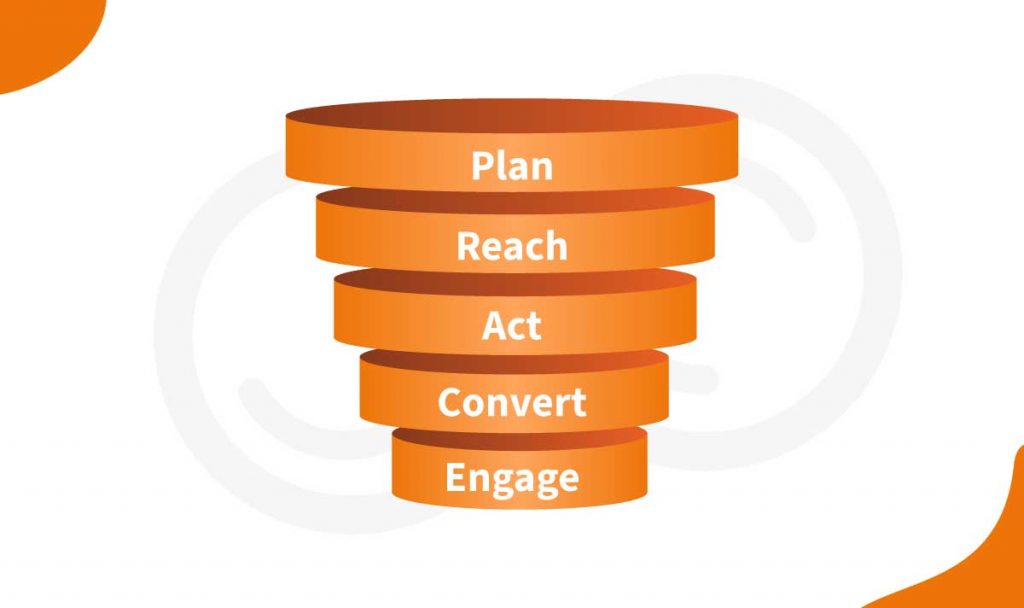
When SEO integrates with your PPC, email marketing, and conversion optimisation efforts, every tactic performs efficiently and effectively.
PPC campaigns convert higher when targeting people already familiar with your brand through organic search. Email campaigns through SEO content get a higher engagement rate. Sales teams close leads faster when prospects have already vetted you through search results.
The businesses that understand SEO ROI are connecting every pound spent to qualified leads, actual conversions, and long-term brand visibility that compounds year after year.
What Does ROI in SEO Actually Mean?
SEO ROI is simply how much revenue your organic search presence generates compared to what you spend achieving it.
The formula itself is straightforward:
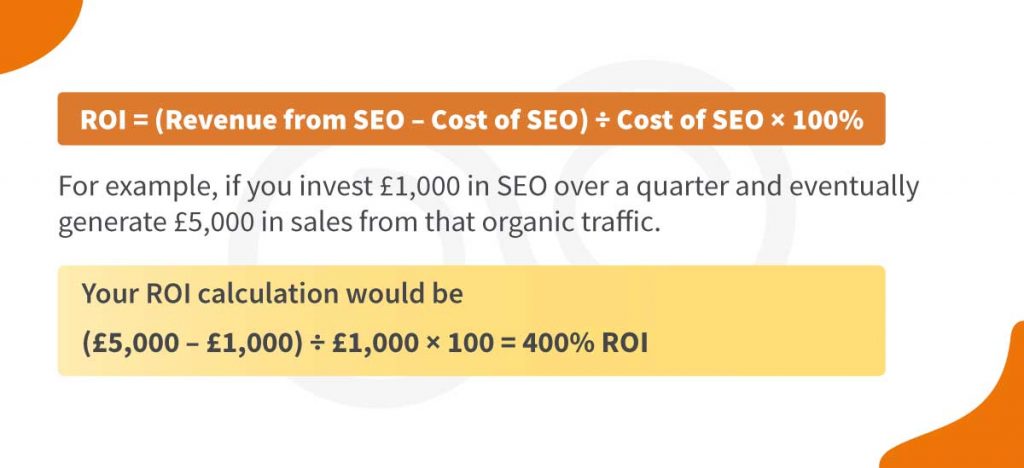
For every pound you invested, you’ve earned four pounds back.
But here’s where most businesses get it wrong. Rankings don’t pay your bills. Traffic doesn’t either. What matters is qualified traffic, the people who find you searching for exactly what you offer and who convert into paying customers.
Would you rather rank first for a keyword that brings 1,000 visitors who bounce immediately, or rank third for a term that brings 100 visitors, 15 of whom become customers?
With a good SEO strategy, you can bring in qualified traffic to your website. But what happens to the traffic in the next step determines your actual ROI for SEO.
If those 100 high-intent visitors land on a poorly designed page, with an unclear call to action, and slower loading times.
This is why the most successful small businesses integrate SEO with CRO strategies
- SEO attracts the right visitors (people actively searching for what you offer)
- CRO converts those visitors into customers (through strategic page design, persuasive copy, trust signals, and frictionless user journeys)
Furthermore, in 2025, SEO ROI includes your visibility in AI-driven search results.
Google’s AI Overviews, voice assistants, and generative search tools increasingly surface top organic content. When your business appears in these AI-curated answers, you’re building brand recognition even before someone clicks.
How to Calculate Your SEO ROI (Step-by-Step)
Calculating SEO ROI requires discipline. You need to track both sides of the equation: what you’re investing and what you’re gaining. Here’s how to do it properly.

Step One: Total Your SEO Investment
Include everything:
- Agency fees or freelancer costs
- In-house staff time (calculate the hours multiplied by their hourly rate)
- Tools and software subscriptions (Google Search Console is free, but Ahrefs, SEMrush, or Screaming Frog aren’t)
- Content production costs (writers, designers, video producers)
- Technical development (site speed improvements, mobile optimisation, schema markup)
Step Two: Measure Your Organic Conversions
This is where Google Analytics 4 and Search Console become essential. You need to know:
- How much traffic comes from organic search
- What do those visitors do on your site
- Which specific actions generate value (purchases, form submissions, phone calls, appointment bookings)
Step Three: Assign Revenue Value Per Conversion
Some conversions have obvious values (a £500 sale is worth £500). Others require estimation:
- What’s the average order value from organic traffic?
- What’s the lifetime value of a customer acquired through SEO?
- For B2B businesses, what’s the average value of a qualified lead?
Step Four: Apply the Formula
For example, if your small business spends £2,000 monthly on SEO activities (content, technical work, tools). Over that month, if you generate:
- 25 phone enquiries worth £200 each in expected value = £5,000
- 15 form submissions worth £300 each in expected value = £4,500
- Total revenue from SEO: £9,500
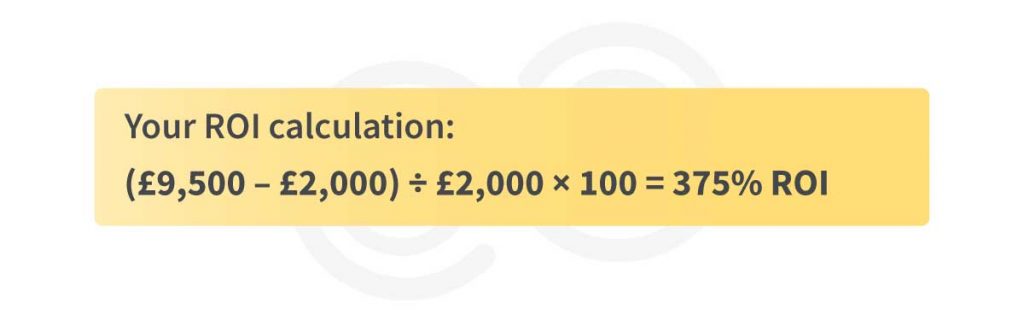
In the first few months, your SEO ROI might be negative or barely break even. Results typically turn positive around six to nine months, and by year one, the numbers often shine. It’s how compound growth works.
What’s a Good SEO ROI for Small Businesses?
Not aspirational figures or best-case scenarios, but realistic expectations based on actual data from businesses like yours.
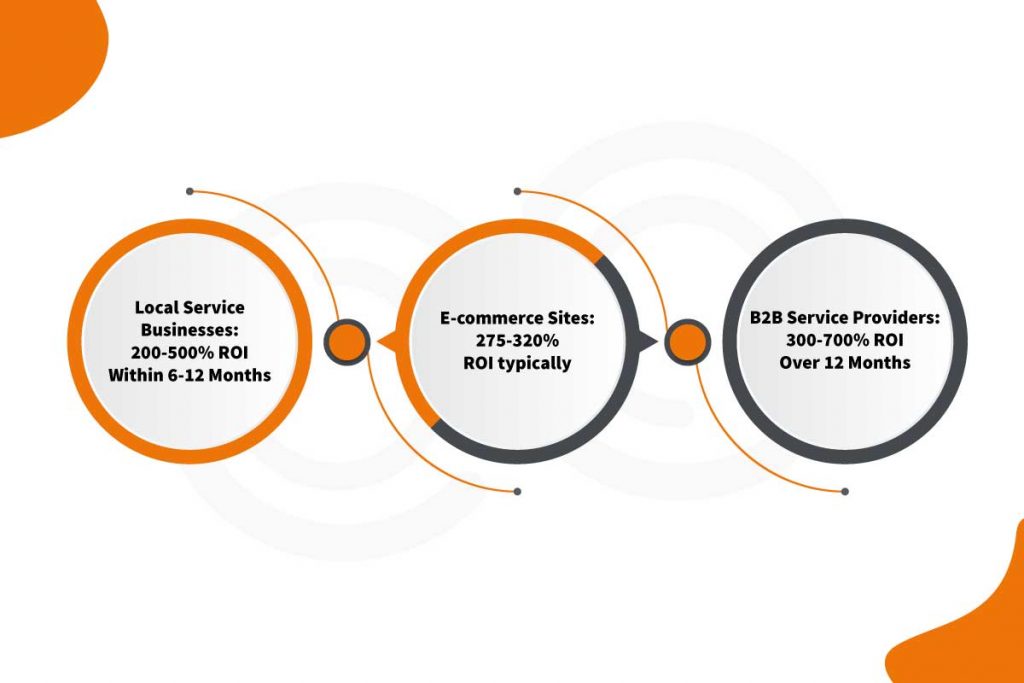
1. Local Service Businesses: 200-500% ROI Within 6-12 Months
Local businesses often see the strongest returns fastest. Because local SEO targets people who are actively searching for services “near me” right now. When a gym in Northampton ranks for “personal trainer Northampton” or “gym near NN1”, those clicks convert at exceptionally high rates.
Survey data shows that 40% of local SEO campaigns achieve 500% ROI or more. That means spending £1,000 returns £5,000 or better.
2. E-commerce Sites: 275-320% ROI typically
Online retailers see solid returns, though often with slightly longer timelines.
Typical e-commerce SEO campaigns deliver approximately 3.2× ROI (about 320%) within nine to twelve months.
In practice, a £5,000 investment in e-commerce SEO frequently generates £20,000 – £25,000 in revenue over the first year, producing 300 – 400% returns. These numbers improve further in years two and three as content libraries expand and domain authority strengthens.
3. B2B Service Providers: 300-700% ROI Over 12 Months
B2B companies experience wider variance. Because lead values and sales cycles vary dramatically.
A marketing agency acquiring £5,000 clients has different economics than an industrial supplier closing £100,000 contracts.
However, data consistently shows B2B SEO delivering 3-7× returns (300-700%) when measured over 12-month periods.
B2B buyers conduct extensive research, but once SEO positions you as the authoritative choice, conversion rates and customer lifetime values make the economics compelling.
How SEO Compares to Other Marketing Channels
Here’s where the story becomes interesting:
| Marketing Channel | Average ROI | Duration of Impact |
| SEO | 500 – 1,300% | Long-term, compounding |
| Content Marketing | 300% | Medium-term |
| PPC Advertising | 200% | Stops when spending stops |
| Email Marketing | 360% | Ongoing with list maintenance |
Studies show organic search drives 53% of all website traffic. That’s more than all other sources combined. Why does SEO outperform paid advertising so significantly?
Because quality content keeps working long after you publish it. A comprehensive guide written today can generate leads for years. A paid ad generates leads only while you’re paying for it.
There’s something else happening in 2025 that amplifies these returns. AI-driven search interfaces, Google’s AI Overviews, ChatGPT, and Perplexity increasingly feature brands with strong organic authority.
When your content appears in AI-generated summaries, you’re reaching audiences without paying for each impression. That compounds your ROI beyond what traditional metrics capture.
The Compound Growth Curve
SEO is fundamentally a long-term investment that amplifies your other digital marketing channels. Understanding the typical timeline helps set appropriate expectations:
| Timeframe | Expected Outcomes |
| 0 – 3 months | Technical fixes, site crawlability, and foundational content |
| 4 – 6 months | Improving rankings, increasing organic traffic, and early conversions |
| 6 – 12 months | Measurable conversions, positive ROI, established momentum |
| 12+ months | Compounding returns, strong domain authority, and reduced acquisition costs |
This growth curve explains why many businesses abandon SEO prematurely. They expect linear growth when they should expect exponential growth.
The first few months feel slow. Then momentum builds. By year two, the returns often accelerate dramatically as your content library and authority compound.
How to Improve Your SEO ROI
Understanding ROI is one thing. Maximising it requires deliberate optimisation across multiple dimensions.
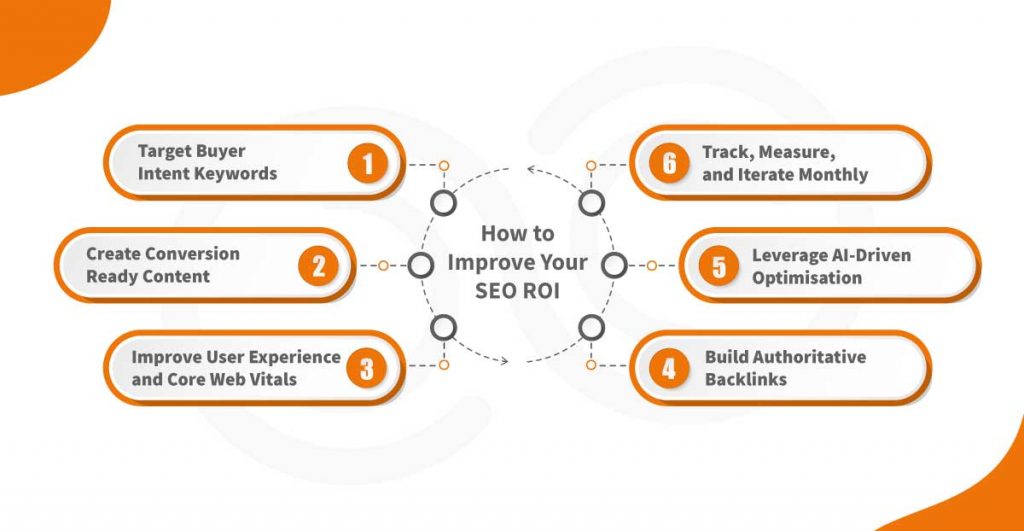
1. Target Buyer-Intent Keywords
Generic keywords attract browsers. Specific buyer-intent keywords attract customers. The difference in ROI is dramatic.
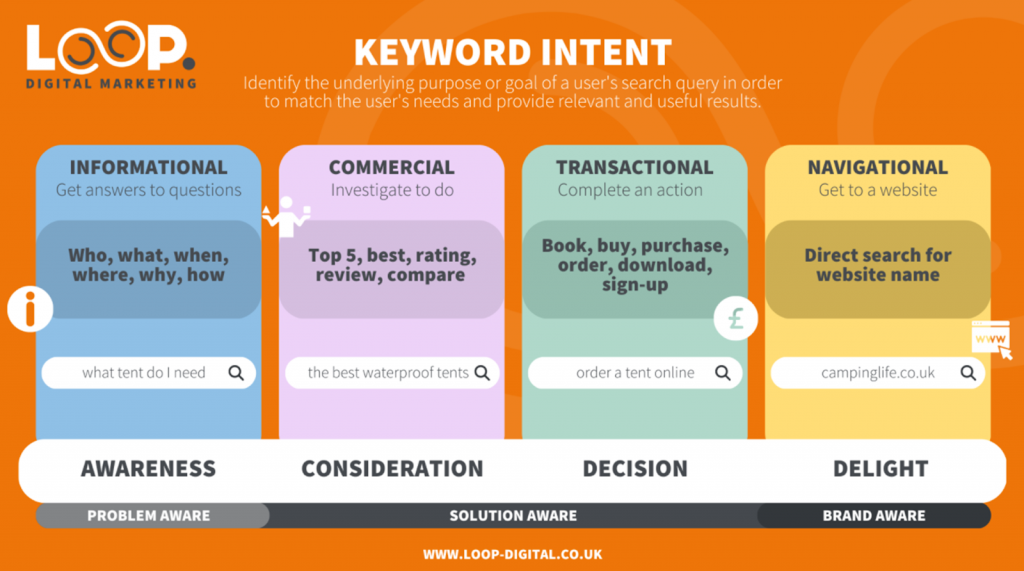
Compare these searches:
- “bathroom design ideas” (informational, low conversion intent)
- “bathroom fitters near NN1” (transactional, high conversion intent)
The first might generate 1,000 visitors with a 0.5% conversion rate (5 customers). The second might generate 100 visitors with a 15% conversion rate (15 customers).
The second delivers 3× more business from 10× less traffic.
2. Create Conversion-Ready Content
Every page should have a purpose. Service pages, location pages, and FAQ pages optimised for local searches convert far better than generic blog posts.
Avoid thin content. Google increasingly rewards comprehensive, genuinely helpful resources. If you’re writing about “commercial property finance,” create the definitive guide, not a 500-word overview. Detail matters.
Match content format to search intent.
Someone searching “how to choose a mortgage broker” wants educational content.
Someone searching “mortgage broker Northampton” wants to see your services, credentials, and contact information immediately. Serving the right content to the right intent improves ROI directly.
3. Improve User Experience and Core Web Vitals
Technical excellence is no longer optional. Google uses UX signals as ranking factors, and users abandon slow or confusing sites immediately.
Priority optimisations:
- Page speed (aim for under 2-second load times)
- Mobile responsiveness (over 60% of searches are mobile)
- Clear navigation (users should find what they need in two clicks)
- Security (HTTPS is mandatory)
- Accessibility (proper heading structure, alt text, readable fonts)
Better UX delivers a double benefit. It helps you rank higher and converts more of the traffic you earn.
4. Build Authoritative Backlinks
Links from reputable sites remain one of the strongest ranking signals. For small businesses, focus on achievable, relevant opportunities:
- Local news coverage or business features
- Industry association memberships and directories
- Partnerships with complementary businesses
- Guest contributions to industry publications
- Sponsorships of local events or organisations
Quality matters infinitely more than quantity. One link from a respected local newspaper or industry authority is worth more than 100 directory links.
5. Leverage AI-Driven Optimisation
AI tools have transformed SEO efficiency. Use them strategically:
- Keyword research tools identify content gaps and opportunities
- AI writing assistants speed content production (whilst requiring human editing)
- Content analysis tools evaluate competitors and suggest improvements
- Internal linking suggestions improve site structure
- Chatbots can identify common customer questions worth addressing in content
Beyond tools, optimise for AI-driven search itself. Implement schema markup (structured data) so search engines understand your content better. Emphasise expertise and authority signals (E-E-A-T) that AI systems value when selecting sources to feature.
6. Track, Measure, and Iterate Monthly
Set aside time monthly to review:
- Which pages generate the most conversions?
- Which pages get traffic but don’t convert? (These need optimisation)
- Which keywords are you ranking for but not targeting deliberately? (Opportunities)
- Where are competitors outperforming you?
The businesses achieving 500%+ ROI aren’t just doing SEO, they’re continuously refining it based on what the data reveals.
Small Business SEO ROI in Action
Here’s how a strategic SEO investment transformed one small business’s bottom line.
The Business
Potters Carpets & Beds is a family-run retailer in Leicestershire with 160 years of trading history. Despite their strong local reputation and loyal customer base, their online presence was virtually invisible. Most business came from word-of-mouth and traditional advertising, leaving them vulnerable as customers increasingly searched online before visiting stores.
The Challenge
With competitors dominating local search results, Potters was missing opportunities daily. When potential customers searched “carpet shops Leicester” or “beds near me,” they simply weren’t showing up. Their outdated website couldn’t compete, and they had no measurable way to track which marketing efforts actually generated sales.
The Investment
Potters is committed to a comprehensive 24-month SEO strategy, including a complete website rebuild, technical optimisation, content development, and integrated PPC management to deliver results whilst organic rankings build momentum.
The Strategy
We rebuilt their digital presence from the ground up, recognising that SEO success depends on more than rankings. It requires a conversion-optimised website and coordinated multi-channel approach:
Their digital presence from the ground up:
- New WordPress/WooCommerce website with intuitive navigation and mobile-first design
- SEO-optimised site structure targeting Leicester and the surrounding areas
- Location-specific content answering real customer questions
- Strategic backlink acquisition to build domain authority
- Google My Business optimisation for local search visibility
- Coordinated PPC campaigns to capture immediate demand whilst SEO matured
The Results After 12 Months
The numbers speak clearly:
- Organic traffic increased 79%
- Keyword rankings more than doubled (from 443 to 910 keywords)
- Clicks increased 73%, impressions up 74% in the final six months
- Average ranking position improved by 17%
- £1,000,000+ in additional revenue generated over 24 months
Why It Delivered Exceptional ROI
Three factors drove these results:
- High-intent targeting: Location-specific keywords captured customers ready to buy, converting at exceptional rates.
- Technical excellence: Fast loading, mobile optimisation, and intuitive navigation improved conversions whilst building authority for higher rankings.
- Local dominance: Optimised Google Business Profile and consistent citations delivered visibility in local search and Maps, driving online and in-store sales.
SEO ROI vs Paid Ads: Long-Term Cost Efficiency
The comparison between SEO and PPC reveals why long-term thinking wins.
The Fundamental Difference
Paid advertising rents visibility. SEO builds equity.
When you run Google Ads, you pay for every click. Stop paying, stop receiving traffic. It’s linear economics: double your budget, double your traffic. Halve your budget, halve your traffic.
SEO works differently. The content you create, the rankings you earn, and the authority you build are assets that continue generating value long after initial creation. Write a comprehensive guide today; it can generate leads for years.
Comparison between SEO and Paid Ads
Data tells a clear story
| Metrics | SEO | PPC |
| Average ROI | 500-1,300% | 200% |
| Time to Results | 3-6 months | Immediate |
| Cost Over Time | Decreases (per lead) | Increases (as competition grows) |
| Duration of Impact | Indefinite (compound growth) | Stops when spending stops |
| Conversion Rate | 2.4-14.6% (depending on intent) | 2-4% |
SEO leads convert at dramatically higher rates.
Organic search traffic converts at approximately 14.6%, compared to just 1.7% for cold outreach and 2 – 4% for paid ads.
Why? Because people trust organic results more than advertisements.
The Hybrid Approach
Smart businesses don’t choose SEO or PPC. They use both strategically.
| Use PPC For | Use SEO For |
| Immediate visibility while SEO builds momentum | Long-term, sustainable traffic growth |
| Testing which keywords and messages convert best | Building authority and trust |
| Seasonal campaigns or limited-time offers | Reducing long-term customer acquisition costs |
| Remarketing to people who’ve visited your site | Creating compounding value from content assets |
Is SEO Worth It for Small Businesses?
Yes, SEO is worth it. But not for the reasons most people think.
SEO is a long-term business asset that compounds in value year after year. Unlike advertising, where value stops the moment you stop paying, SEO builds equity.
Every ranking earned, every authoritative page created, every quality backlink acquired, these are assets that continue generating returns indefinitely.
Whilst PPC delivers 200% ROI that stops when spending stops, SEO consistently delivers 500-1,300% ROI that compounds annually. For small businesses, this difference between renting visibility and building equity determines long-term viability.
There’s something else worth considering. In 2025’s AI-driven search landscape, organic authority matters more than ever. When Google’s AI Overviews, ChatGPT, or Perplexity cite sources or recommend businesses, they’re drawing from authoritative organic content.
Paid ads don’t feature in these AI-curated recommendations. Your SEO investment positions you for visibility in both traditional search and the emerging AI search ecosystem.
The businesses that thrive aren’t asking whether they can afford SEO. They’re asking how much faster they can scale it.
Ready to Calculate Your SEO ROI?
Understanding SEO ROI is just the beginning. The real challenge is implementing a strategy that delivers these returns whilst maintaining focus on what actually matters: attracting qualified customers who choose your business.
Here’s what we believe
The future belongs to businesses that understand SEO isn’t about gaming algorithms or chasing rankings. It’s about creating genuinely valuable content, building authentic authority, and deserving the visibility you earn.
We create SEO campaigns that adapt to algorithm changes. We help businesses build sustainable organic visibility that compounds in value year after year. Whilst others get lost in tactical details, we maintain focus on what drives real business outcomes: qualified traffic, conversions, and measurable revenue growth.
Book your free SEO audit today to see exactly how much revenue potential your current organic presence is leaving untapped.
If you have any queries, book a free consultation to discuss how SEO can transform your customer acquisition economics.
The question isn’t whether SEO delivers ROI.
The question is how much more profitable your business could be if you stopped renting visibility and started building equity.
FAQs
1. How profitable is SEO for small businesses?
Exceptionally profitable. Small businesses typically see 200 – 500% ROI within 12 months, meaning every £1 invested returns £2 – £5 or more. Unlike paid ads that stop when spending stops, SEO compounds year over year.
By year two, SEO often delivers most new customers at a fraction of other channels’ cost per acquisition. Profitability materialises after months 6-9 as rankings solidify.
2. How do you calculate ROI from SEO?
Formula: (Revenue from SEO – Cost of SEO) ÷ Cost of SEO × 100%. Total all costs (agency fees, tools, content, staff time), then track revenue using Google Analytics 4, Search Console, and your CRM.
Example: £2,000 spent generating £8,000 sales = 300% ROI. Challenge: accurate attribution, track assisted conversions since SEO influences multiple touchpoints.
3. How long does it take to see ROI from SEO?
Plan for 6-12 months for meaningful ROI. Modest results appear in months 4-6, positive ROI around months 6-9, and substantial returns by month 12. Established sites might see results in 3-6 months; new domains in competitive markets take 12-15 months. Compound growth accelerates months 12-24.
4. Is SEO more cost-effective than paid advertising?
Yes, dramatically so long-term. SEO delivers 500 – 600% ROI versus PPC’s 200%. Organic traffic converts at 14.6% compared to PPC’s 2 – 4%. SEO costs per lead decline whilst PPC costs increase. By month 12, SEO delivers leads at 30-50% the cost of PPC. Trade-off: PPC gives immediate results, SEO needs 6-12 months. Best approach: combine both, PPC for quick wins, SEO for sustainable efficiency.
5. What’s a realistic SEO budget for small businesses?
SEO investment varies significantly based on industry competitiveness, business goals, and whether you’re integrating with other channels (CRO, PPC, content marketing) for maximum efficiency. Higher SEO budgets accelerate timelines to positive ROI.
Most small businesses invest £800 – £2,000 monthly for effective SEO, with £1,200 – £1,500 being the sweet spot for consistent growth. Local service businesses in less competitive markets can start at £800 – £1,200, whilst e-commerce or highly competitive sectors typically need £1,500 – £3,000 to see meaningful results.
6. How do AI and generative search affect SEO ROI?
AI enhances SEO ROI significantly. AI Overviews prioritise authoritative content; appearing in AI summaries provides visibility without paying per impression. AI values E-E-A-T signals more than traditional algorithms, making genuine authority more valuable. Structured data and schema markup improve chances of AI citation.
Looking for your next opportunity?
Digital marketing careers
We’re always on the lookout for talented individuals to join our ever growing team. If you think you’d be a great match for Loop Digital, we’d love to hear from you.







Join 300+ business owners getting weekly growth strategies - subscribe now.
"*" indicates required fields