What Google's Latest Updates Mean for Local SEO in 2026
Read time: 12 Minutes
Google fundamentally changed how it evaluates, reports, and surfaces local businesses throughout 2025. What worked brilliantly for local SEO just twelve months ago won’t keep you visible in 2026.
Why does this matter so urgently?
76% of people who search for a local business on mobile visit that business within 24 hours, with 28% resulting in a purchase.
46% of all Google searches are seeking local information
“Near me” searches have exploded by 900% in the last two years
Businesses earning visibility in Google’s top three local pack positions receive 126% more traffic and 93% more user actions like calls and directions
The way people find cafés, home improvement services, solicitors, gyms, and salons has evolved beyond traditional search.
The way people search has evolved completely:
Conversational, Question-Based Queries
Instead of typing “plumber Northampton,” people now search as they speak:
“Who can fix my electrics tonight?”
“What’s the best type of window for noise reduction?”
“Can you find me a plumber in Northampton?”
Voice and Visual Search
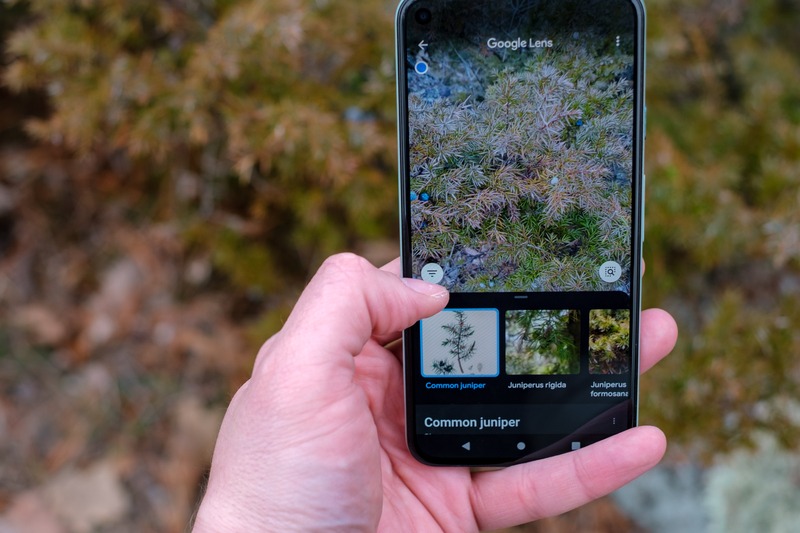
People increasingly use voice assistants or point their phone camera at businesses instead of typing. Google Lens with Gemini allows users to photograph any shopfront and instantly ask questions about opening hours, reviews, or availability.
AI Is Handling Most of the Heavy Lifting
By 2026, AI-powered assistants will handle roughly 25% of global search queries (Gartner). Businesses already see 3-8 times higher conversion rates from traffic originating in AI search compared to traditional searches.
Search Is No Longer about SERP Rankings
Today, search means:
AI Overviews and conversational LLM responses
Visual and voice search through Lens and assistants
Entity-rich knowledge panels
Map listings and local packs
Classic organic results plus PPC
Shopping and Local Service Ads
To win customers in 2026, you must show up everywhere your customers search, across AI answers, map packs, organic results, and visual discovery. No single tactic captures that entire journey, which is exactly why optimising for total Google visibility has become essential.
You could either be a single-location business or manage multiple sites across the UK; understanding Google’s latest shifts helps with your business growth and makes sure you’re not left behind.
The Three Factors Reshaping Local SEO in 2026
Reviews and Behaviour Now Drive Local SEO Rankings
Google’s systems now parse review content for relevance, identifying mentions of specific services, location references, and authentic customer experiences.
A dozen detailed, context-rich reviews from genuine customers outperform fifty generic ratings with no text. Review recency matters increasingly, but Google balances it with overall volume, rating quality, and response patterns.
A business with consistent recent reviews demonstrates ongoing customer satisfaction, but won’t automatically outrank established competitors with larger review counts.
When searchers click to call your business, request directions, visit your website, or spend time viewing your photos, Google interprets these actions as votes of relevance and quality.
How Landmark-Based Navigation Changes Local Discovery
Google’s integration of Gemini AI into Maps represents the most significant update to the platform since its inception. What was once primarily a navigation tool has evolved into an AI-powered discovery engine with conversational capabilities.
Google achieves this by cross-referencing its database of 250 million places with Street View imagery, identifying buildings and businesses that are visually distinctive.
For local businesses, proximity to well-known landmarks has become an unexpected advantage. A solicitor’s office located “opposite Northampton Railway Station” or “next to the Royal & Derngate Theatre” gains inherent findability that a technically superior competitor on a side street off St Giles lacks.
Visual Search Through Lens
Lens with Gemini allows users to point their phone camera at any business and immediately ask questions about it.
“Is this place busy right now?”
“What’s the ambience of the place like?”
“Do they have seating available?”
Someone walking down the high street no longer needs to know which businesses exist; they can point their phone at any shopfront and instantly access reviews, photos, busy times, and specific attributes.
This feature demands that businesses optimise for visual discoverability. High-quality exterior photos clearly showing your shopfront and signage have become essential.
Accurate attribute tagging across every relevant field, such as wheelchair accessibility, outdoor seating, Wi-Fi availability, and dog-friendliness, directly answers the questions people ask through Gemini.
The num=100 Change in Google Search Console
Google removed the num=100 parameter from search results. This parameter previously allowed tools to retrieve up to 100 results per search query. Without it, tracking tools could only access the first ten results.
For businesses ranking in positions 11-100, still valuable for long-tail queries, those rankings effectively disappeared from reporting.
If you’re tracking local search performance and saw dramatic drops in reported impressions during Q3 2025, you may not have actually lost visibility. The measurement system changed beneath you.
What Ranks in the Google Local Pack in 2026
Despite all the latest updates in ranking signals, certain foundational elements remain absolutely critical.
Getting Your Primary Google Business Profile Category Right
Primary category selection represents the single highest-weight foundational signal in local SEO. This isn’t the category that broadly describes your business; it’s the category that matches the main service generating most of your revenue.
A digital marketing agency might offer SEO, PPC, social media management, web design, and content marketing. It’s tempting to choose “Marketing Agency” as a broad umbrella category.
65% of enquiries come from “SEO services Northampton” or “local SEO agency near me“. Most revenue derives from ongoing SEO retainers. Keyword research shows high search volume for “SEO agency Northampton” with medium competition
Profile Completeness and Service Relevance
A fully completed Google Business Profile signals to Google that you’re a legitimate, actively managed business. Every empty field represents a missed opportunity and a small trust deficit.
The Services section allows you to list specific offerings with descriptions. The Services section allows you to list specific offerings with descriptions. A digital marketing agency listing “SEO Audit & Strategy,” “Google Ads Management,” “Social Media Marketing,” and “Conversion-Focused Landing Page Design” as separate services provides clear signals about query relevance.
Proximity vs Trust
Physical distance to the searcher remains a core ranking input; you cannot optimise your way around geography.
However, amongst businesses at similar distances, trust signals now provide the differentiation. Two cafés equidistant from a searcher compete on reviews, engagement, profile completeness, and behavioural signals.
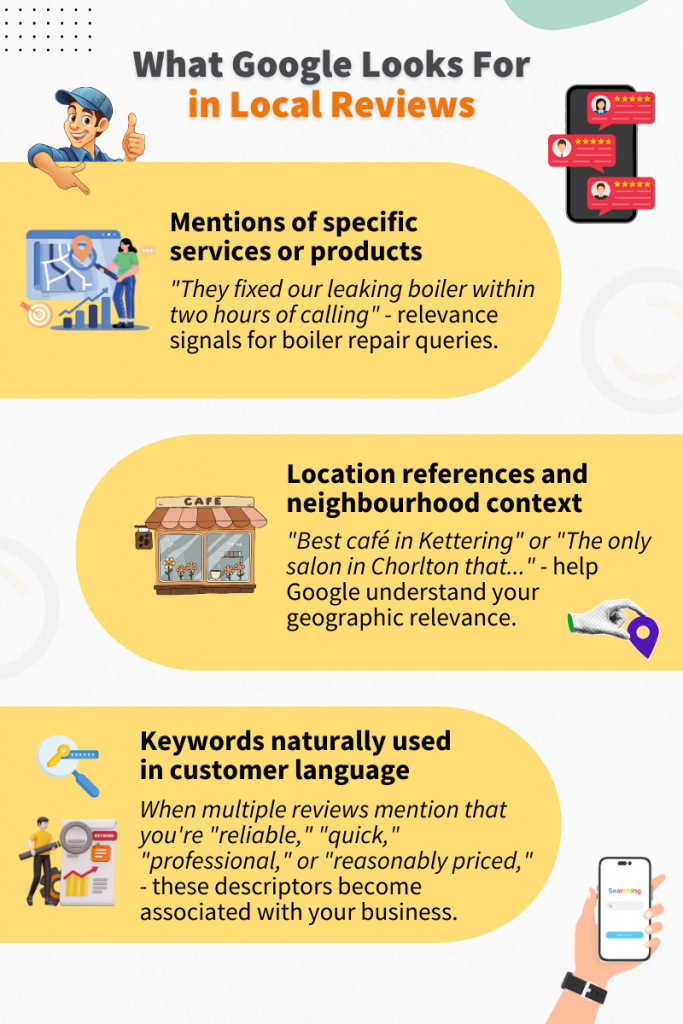
Mentions of specific services or products: “They fixed our leaking boiler within two hours of calling” provide clear relevance signals for boiler repair queries.
Location references and neighbourhood context: “Best café in Kettering” or “The only salon in Chorlton that…” help Google understand your geographic relevance.
Keywords naturally used in customer language: When multiple reviews mention that you’re “reliable,” “quick,” “professional,” or “reasonably priced,” these descriptors become associated with your business in Google’s understanding.
Note: Aim for a steady flow of 2 – 4 reviews per month. This consistent cadence proves more valuable than occasional bursts of ten reviews followed by months of silence.
What Hurts Your Local Rankings in 2026
Keyword-stuffed business names
“Northampton’s Best Vehicle Finance Service | Low Rates | Fast Approval | First Time Buyers” violates Google’s guidelines and triggers penalties. Your business name should match exactly what appears on your physical signage.
Wrong primary category
Choosing an irrelevant category to gain visibility in unrelated searches backfires. Google’s systems detect when your category doesn’t align with your actual offerings.
Inaccurate hours
Nothing frustrates potential customers like travelling to a business Google indicated was open, only to find it closed. Repeated instances teach Google that your information is unreliable, suppressing visibility.
Low-quality or fake reviews
Google’s systems have become remarkably effective at identifying inauthentic reviews. Getting caught results in review removal and potential profile suspension.
A plumber shouldn’t have a single “Services” page listing everything. They need separate pages for Emergency Plumbing Repairs, Boiler Installation, Central Heating Services, Bathroom Fitting, and Drain Unblocking.
Each page targets specific search queries and provides useful information to both the user and Google.
Location-Specific Service Pages
Serving multiple locations demands dedicated pages combining service and geography.
A kitchen fitter serving five areas should create location-specific service pages:
“Kitchen Installations in Bedford,”
“Kitchen Refurbishments in Duston,”
“Bespoke Kitchen Design in Far Cotton.”
Each includes location-specific content, local landmarks, neighbourhood references, and case studies from that area.
What Modern Local Pages Must Contain
1. FAQs Addressing Real Questions
Answer actual questions prospective customers ask:
“How quickly can you come out for emergencies?”
“Do you charge for quotes?”
“What areas do you cover?”
2. Pricing Context
Whilst few businesses publish exact prices for bespoke services, providing pricing context builds trust. “Standard UPVC window replacements for a three-bedroom semi typically range from £3,500 to £4,500, depending on window size, style, and glazing specifications“, gives visitors useful information.
3. Service Process Explanation
Walk potential customers through what working with you looks like. “When you enquire about business finance services, we answer within 2 hours, arrange a free consultation at your convenience, assess your financial situation and needs, research the entire market for the best rates, handle all paperwork and lender communication, and keep you updated at every stage until completion.
4. Natural Geographic References
Include location references that feel natural: neighbourhood names, nearby landmarks, and local characteristics. Someone in Chorlton searching for plumbers wants to know you understand Chorlton’s housing stock and local context.
5. Clear Calls-to-Action
Make contacting you obvious and easy. Phone number, contact form, and callback request should feature prominently above the fold and repeated at content end.
Structured vs Unstructured Citations for Local SEO
Structured citations (consistent listings of your business name, address, and phone number across directories) help establish legitimacy. But unstructured mentions have gained unexpected importance for AI visibility.
When large language models respond to queries about local services, they synthesise information from across the web.
A business mentioned in local news coverage, community blog posts, council websites, and business association pages accumulates credibility signals that purely SEO optimised websites cannot replicate.
Latest Updates in AI, Voice and Conversational Local Search
“Which car wash near Bedford has the best reviews and offers interior valeting?” – Combining location, service specifics, and quality indicators demands structured data clarity and review content alignment.
Structure Content for Intent Layers
Your website and GBP must address not just what you do, but the specific circumstances people face when they need you.
Emergency plumbers should explicitly state 24/7 availability, same-day service, and typical response times.
Align Attributes With Expectations
Every attribute field represents potential query matching. If you’re dog-friendly, mark it. If you offer outdoor seating, specify it.
Incomplete attributes mean AI cannot match you to queries requiring those characteristics.
“We understand boiler breakdowns always happen at the worst possible time. That’s why we offer 24/7 emergency callouts across Bedford with typical arrival times under two hours” Addresses conversational search patterns better than generic service descriptions.
Your 2026 Local SEO Action Plan
Getting local SEO right in 2026 isn’t a one-time fix – it’s a systematic, year-round approach. Here’s how to structure your efforts across four strategic phases.
Stage 1: Audit and Fix Foundations
Start the year by ensuring your fundamentals are bulletproof. Complete a thorough Google Business Profile audit – verify your primary category matches your main revenue generator, confirm your pin location is precisely accurate, and fill every field Google offers.
On your website, create dedicated pages for every major service you offer. If you serve multiple locations, build location-specific service pages with genuine local content – not template pages with swapped town names.
Stage 2: Build Trust Signals
With foundations solid, focus on the signals that now dominate rankings: reviews, engagement, and citations.
Launch a systematic review generation system. Target 2 – 4 new reviews monthly – consistent cadence matters more than occasional bursts. Respond to every review within 48 hours.
Upload 20-30 high-quality photos covering exterior shots, authentic interiors, team introductions, and service examples. Then maintain momentum with weekly additions.
Build citations across key local directories, industry-specific listings, and business associations. Ensure your NAP (Name, Address, Phone) is identical everywhere.
Stage 3: Optimise for AI & Maps
Update your Google Business Profile description to mention nearby recognisable landmarks: “Located opposite the Tesco Express on the high street.”
Create conversational content that answers specific customer questions:
“How quickly can you come out?”
“Do you work evenings?”
“What’s included?”
Address not just what you do, but when, how quickly, and why customers should choose you.
Enhance visual assets with descriptive filenames. Add video content where appropriate, premises tours, service explanations, or team introductions.
Stage 4: Evaluate and Scale
Review performance across metrics that matter: GBP views, click-to-call rates, direction requests, review growth, and actual conversions from local search traffic.
Test variations of your GBP description, post formats, and primary images to identify what drives the highest engagement.
Deepen local authority through business associations, local media relationships, and community partnerships that generate natural mentions.
Let Loop Digital Handle It For You
That’s a lot to manage whilst running your business. Make local search work for you, not your competitors.
At Loop Digital, we specialise in practical, results-driven local SEO for businesses across the UK and beyond. We translate the latest updates – from AI-powered Maps and shifting ranking factors to review algorithms and reporting changes – into real-world growth.
Whilst your competitors scramble to understand what changed, you’ll be implementing strategies that actually work.
What we do for you
Local SEO: Optimise your Google Business Profile, local citations and hyper-local landing pages so you appear for searches from your area specifically.
On-page & content: Create answer-first copy, FAQ schema and location-rich content that serves local searchers instantly and ranks for conversational AI queries.
Reputation & reviews: Build and manage local reviews and case studies to strengthen credibility and local trust signals that now dominate rankings.
AI-ready strategy: Prepare your brand for Gemini search, visual discovery, voice queries, and next-generation Maps navigation.
We’ll show you exactly what’s holding your rankings back, which opportunities you’re missing, and how much revenue is slipping through the cracks.
Book a free 30-minute consultation with our SEO specialists. Let’s have a straightforward conversation about your business goals, your current local presence, and the specific steps needed to turn local searches into tangible growth.
FAQs
Why did my impressions drop suddenly, even though my rankings stayed the same?
Google removed the num=100 parameter in September 2025, fundamentally changing how tracking tools measure impressions. Tools could previously retrieve up to 100 results per query, but now only access the first 10 positions. If you ranked in positions 11-100 for long-tail queries, those impressions vanished from reports even though your actual visibility didn’t change. Focus on clicks, calls, and direction requests rather than raw impression counts; these represent actual customer interest.
How does Gemini in Google Maps actually affect local SEO rankings?
Gemini integration doesn’t directly change ranking algorithms, but it fundamentally alters how people discover businesses. Landmark-based navigation means proximity to recognisable landmarks enhances findability. Visual search through Lens requires high-quality photos and accurate pin locations. Conversational queries demand that your attributes, photos, and reviews answer specific questions. Businesses optimised for visual recognition and authentic imagery gain visibility that traditional text-only optimisation cannot achieve.
Are reviews really more important than backlinks in 2026?
For local pack and Maps rankings, yes, absolutely. Reviews directly influence both rankings and click-through rates. Review count, recency, and content relevance rank among the top local signals. Backlinks still matter for organic website rankings, but for local pack visibility, where most local search clicks occur, reviews, behavioural engagement, and Google Business Profile factors dominate.
How often should I update my Google Business Profile?
Weekly minimum for photos, even smartphone shots, demonstrates an active presence. Update hours immediately when changes occur. Post weekly updates. Respond to reviews within 48 hours. Add new services as offerings expand. Google favours actively managed profiles over set-and-forget listings.
Akshay Kumar is a seasoned digital marketing professional with over five years of proven experience delivering measurable results for brands across diverse sectors. Holding a Master of Business Administration, Akshay blends strategic insight with deep technical SEO expertise to ensure every project achieves lasting value and impact.
Specialising in comprehensive technical SEO audits, Akshay is adept at diagnosing and resolving complex site issues from 5XX and 4XX errors to missing metadata, broken links, and crawlability problems. His technical fixes not only restore site health but also boost search visibility, helping clients secure a competitive edge. Coupled with effective outreach strategies for high-quality link building, he crafts end-to-end SEO solutions that strengthen online authority.
Passionate about staying ahead of algorithm updates and emerging trends, Akshay combines analytical precision with creative problem-solving. Outside work, he’s a dedicated Hot Wheels collector and film enthusiast, often drawing inspiration from cinematic storytelling to fuel his innovative marketing approach.
Looking for your next opportunity?
Digital marketing careers
We’re always on the lookout for talented individuals to join our ever growing team. If you think you’d be a great match for Loop Digital, we’d love to hear from you.