

Posted on 29/05/2026 by Krishna Priya
Structured Vs Unstructured Citations in Local SEO
Read time: 14 minutes
Citations remain a crucial, yet often misunderstood, component of local SEO. In the early days of local search, many regarded citations as a quick “ranking hack”. In reality, citations aren’t shortcuts to the top of the SERPs; they are a foundation for trust, data accuracy and discoverability.
Well-optimised citations ensure search engines and customers see consistent business information.
This topic is especially important now because of the rise of AI-driven, entity-oriented search. Modern search engines and conversational AIs source factual business details from many places, including online directories and local content.
Let us clarify exactly what structured and unstructured citations are (and aren’t), discuss their real impact.
What are Citations
A citation is any third-party online mention of a business’s core identifying details. Put plainly, it’s when another website lists or mentions your business name, address or phone number.
Citations typically include your NAP (Name, Address, Phone) data, and sometimes other info like website URL, business category or opening hours.
Crucially, a citation is not the same as a backlink or a review. A citation may or may not contain a clickable link; it’s simply a reference to your NAP (or similar data) on another site. It is also not a customer review, and it is not your Google Business Profile itself. Instead, think of citations as “digital mentions” that platforms use to verify legitimacy and consistency.
Search engines use citations as trust signals: consistent mentions across the web help confirm your business really exists in the claimed location. By comparing your citations from independent sources, algorithms can reduce misinformation and build confidence in your data.
- Typical elements of a citation: Business name; street address (including city, postcode); local phone number. Many citations also list your website URL, business category, and opening hours.
- Citation vs backlink: A backlink must be clickable; a citation may just be text.
- Citation vs review: User reviews are separate content (though both live on review sites).
- Citation vs Google Business Profile listing: The GBP (Business Profile) is one structured platform’s listing, whereas citations encompass any online mention.
What are Local Citations?
When we talk about local citations, we mean any citation that ties your business to a geographical context. Local citations connect your business to a place or area. For example, a directory entry like “Loop Digital – SEO agency in Northampton” is a local citation because it mentions your name alongside your location.
Consistent local citations help search engines interpret where you operate. Consistent NAP information provides “essential geographic data” that helps Google determine proximity. In effect, local citations boost your visibility for queries in that area by confirming relevance (your business offers that service) and distance (it’s in the right locale).
Types of citations
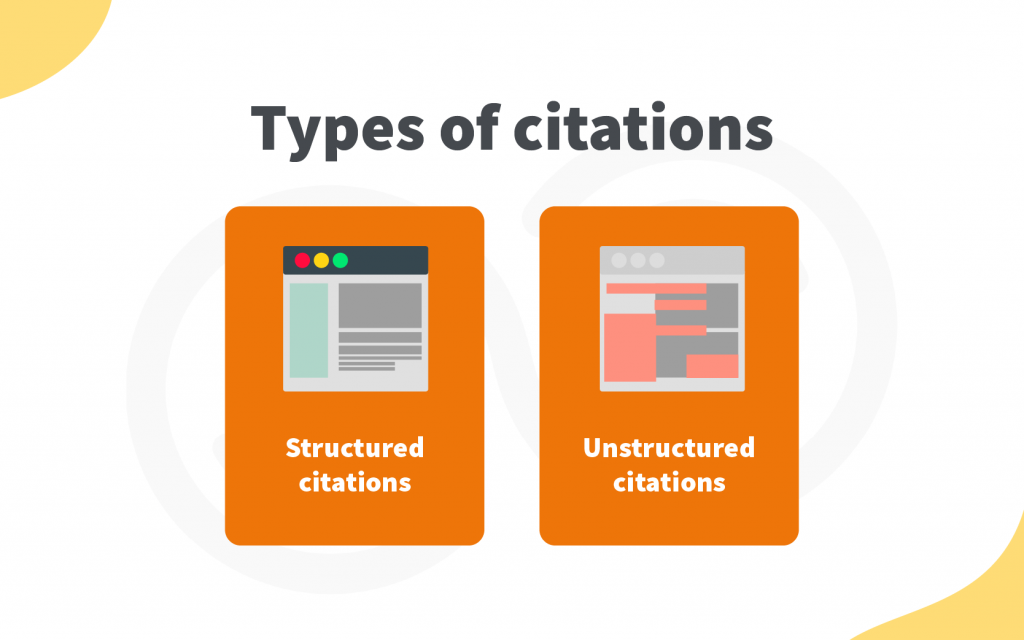
Local citations generally fall into two broad categories: structured and unstructured. In short, structured citations are formal business listings on directories or mapping platforms (with fixed data fields), while unstructured citations are informal mentions of your business in online content.
What are Structured Citations?
Structured citations are formal, database-style listings of your business information. They exist on websites that have dedicated fields for each piece of data. For example, a Google Business Profile, a Yellow Pages listing, or a Yelp page will have specific slots for Business Name, Address, Phone, etc.
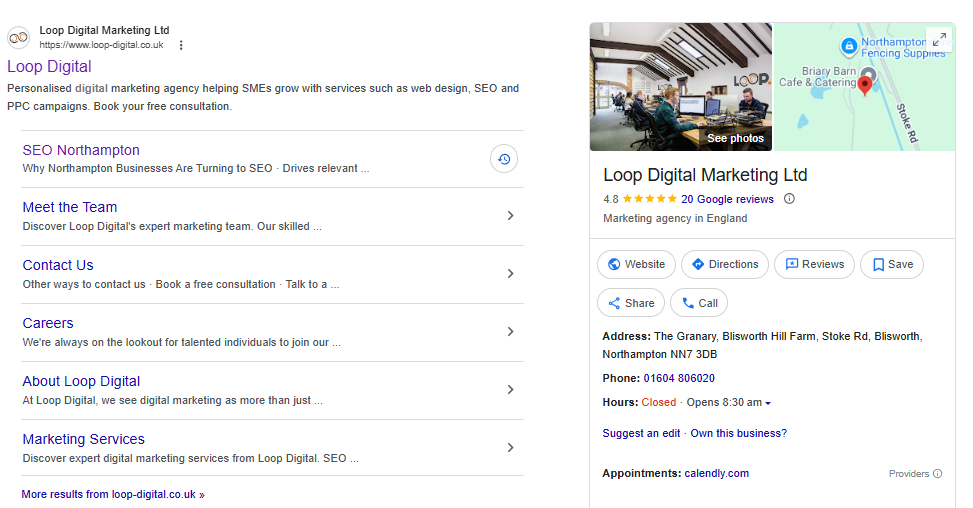
In other words, these citations live in fixed fields that you or the directory controls.
Because the fields are standardised and machine-readable, structured citations function like official digital records of your company. You, as the business owner, often create or claim these listings and can update them directly.
Where structured citations live
Structured citations typically appear on major local directories and mapping platforms. Common examples include:
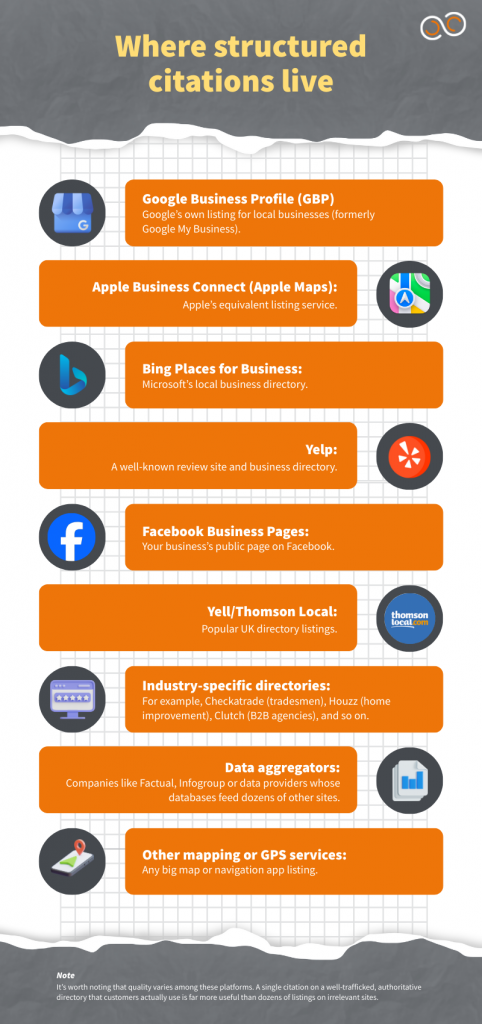
- Google Business Profile (GBP): Google’s own listing for local businesses (formerly Google My Business).
- Apple Business Connect (Apple Maps): Apple’s equivalent listing service.
- Bing Places for Business: Microsoft’s local business directory.
- Yelp: A well-known review site and business directory.
- Facebook Business Pages: Your business’s public page on Facebook.
- Yell/Thomson Local: Popular UK directory listings.
- Industry-specific directories: For example, Checkatrade (tradesmen), Houzz (home improvement), Clutch (B2B agencies), and so on.
- Data aggregators: Companies like Factual, Infogroup or data providers whose databases feed dozens of other sites.
- Other mapping or GPS services: Any big map or navigation app listing.
Note
It’s worth noting that quality varies among these platforms. A single citation on a well-trafficked, authoritative directory that customers actually use is far more useful than dozens of listings on irrelevant sites.
Why are Structured Citations Important?
Structured citations play a vital, if indirect, role in local SEO and AEO aspects. They confirm your legitimacy and consistency. When Google sees your name, address and phone number identical across its own profile and other trusted directories, it gains confidence that your business is real and located where you say it is.
Consistent structured citations also prevent confusion: outdated or conflicting listings can frustrate customers (for example, arriving at an old address or calling a disconnected number).
Well-maintained structured citations establish trust with both users and search engines. When search engines find identical NAP information across many reputable sites, “it confirms your data is correct,” and they reward that trust with better visibility.
What are Unstructured Citations?
Unstructured citations are informal mentions of your business information in content that isn’t set up like a directory listing. They occur naturally when third parties reference your business. There are no fixed fields; your name, address, or other details might appear in flowing text or as part of an article.
For example, if a local blogger writes a post saying, “We tried the new cafe Alpha Bistro at 123 High Street, and it was great,” that mention of “Alpha Bistro” and its address is an unstructured citation.
You don’t control these directly, as they come from other publishers or users, and they often aren’t easily parsed by machines. Instead, they are part of the broader web of references that signal your presence.
Common Types of Unstructured Mentions
Unstructured citations can appear virtually anywhere online. Common examples include:
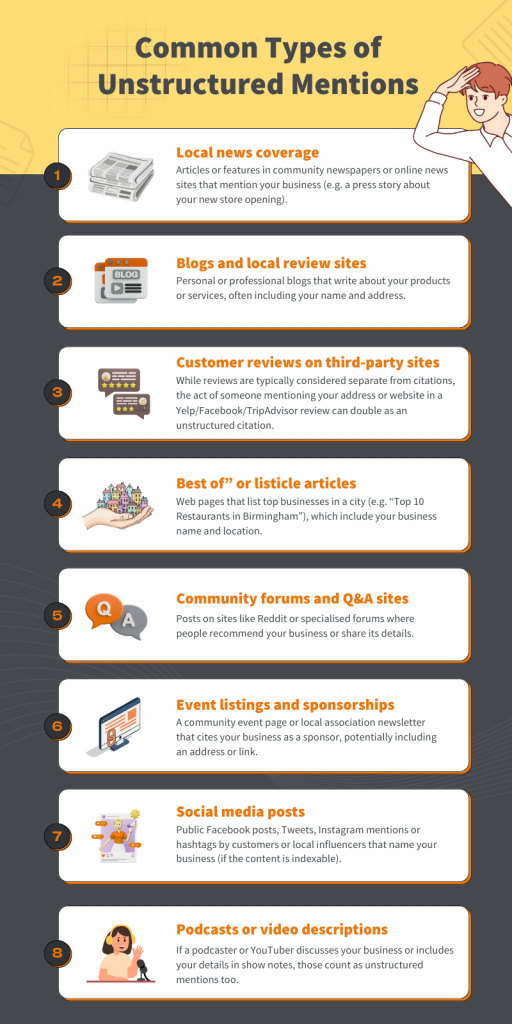
- Local news coverage: Articles or features in community newspapers or online news sites that mention your business (e.g. a press story about your new store opening).
- Blogs and local review sites: Personal or professional blogs that write about your products or services, often including your name and address.
- Customer reviews on third-party sites: While reviews are typically considered separate from citations, the act of someone mentioning your address or website in a Yelp/Facebook/TripAdvisor review can double as an unstructured citation.
- “Best of” or listicle articles: Web pages that list top businesses in a city (e.g. “Top 10 Restaurants in Birmingham”), which include your business name and location.
- Community forums and Q&A sites: Posts on sites like Reddit or specialised forums where people recommend your business or share its details.
- Event listings and sponsorships: A community event page or local association newsletter that cites your business as a sponsor, potentially including an address or link.
- Social media posts: Public Facebook posts, Tweets, Instagram mentions or hashtags by customers or local influencers that name your business (if the content is indexable).
- Podcasts or video descriptions: If a podcaster or YouTuber discusses your business or includes your details in show notes, those count as unstructured mentions too.
Why Unstructured Citations are Important?
Unstructured citations are valuable for building awareness and authority. They often act like real-world endorsements when a trusted publisher or influencer mentions you, which signals relevance and credibility to both searchers and search engines.
For example, a local lifestyle blogger reviewing your café isn’t just handing out free marketing; they’re also giving your business a vote of confidence.
These organic mentions increase your brand’s visibility by exposing it to new audiences. They often contain context that helps define what your business is known for (e.g. “SEO agency in Leicester”), which reinforces topical relevance. Unstructured citations can also drive direct referral traffic.
If a blog or news piece links to your site or social profile, interested readers may click through. Even without a direct link, a reader searching for that mention may discover you.
How Citations Influence Local SEO?
Citations influence local SEO and AEO indirectly by establishing a consistent, trustworthy presence. A strong citation profile helps with key local ranking considerations:
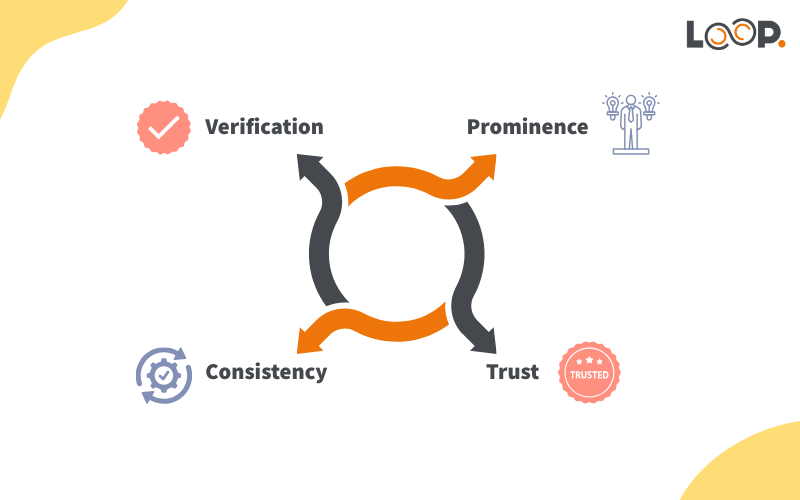
Verification
Citations help claim and verify your Google Business Profile and other listings. Google explicitly checks that your GBP info matches what’s on the web. A consistent citation profile (same NAP everywhere) gives Google confidence in your data.
Consistency
Accurate, up-to-date citations ensure search engines and users get the correct info. If your business moves or changes phone numbers, having all citations updated prevents penalties. As one analysis found, Google prefers 50 accurate, consistent citations over 150 that contain errors.
Prominence
A moderate citation footprint signals legitimacy. While not as powerful as backlinks or reviews, a reasonable number of authoritative citations shows that many sources acknowledge your business. This contributes to your prominence in the local market.
Trust
Consistency in citations builds trust with both search engines and potential customers. When Google sees matching info across sources, it is more likely to trust and display your listing prominently.
A Quick Comparison Between Structured and Unstructured Citations
| Factor | Structured Citations | Unstructured Citations |
| Format | Fixed fields (NAP, category, hours, etc.) | Natural language within content |
| Where they appear | Directories, maps, business databases | Blogs, news articles, reviews, social posts, PR coverage |
| Who controls them | Usually business-controlled (claimed profiles) | Controlled by third parties (earned, not owned) |
| Ease of creation | Easier to build and manage systematically | Harder to earn (requires PR, reputation, relationships) |
| Scalability | Highly scalable (you can create many listings) | Less scalable (quality mentions take effort) |
| Primary function | Data accuracy and legitimacy | Authority, reputation, and visibility |
| NAP rigidity | High consistency is critical | Flexible, where natural variations are normal |
| Traffic potential | Moderate (depends on directory usage) | Often higher when featured on popular sites |
| SEO impact | Foundational trust signal | Amplifying signal for prominence and authority |
| AI/entity relevance | Reinforces factual entity data | Reinforces reputation and contextual understanding |
How Citations Fit into Modern Local Search Algorithms?
Citations align closely with the core pillars of local ranking algorithms
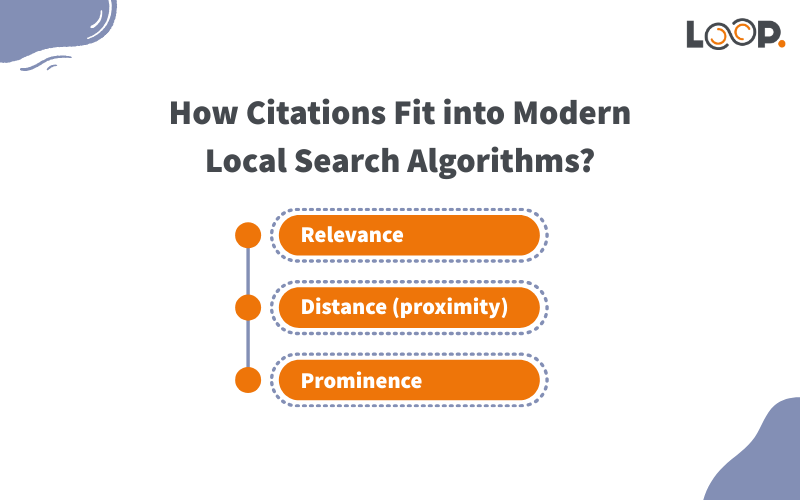
- Relevance
- Distance (proximity)
- Prominence
A well-managed structured citation (like an optimised GBP listing) provides clear relevance signals, as it tells Google what category you are and what local queries you satisfy.
Your address in those citations also establishes distance: it ties your business to a geographic point on the map.
Meanwhile, the total number and quality of your citations contribute to prominence: the more (and the more authoritative the sources), the more Google views your business as well-known and established locally.
In practice, this means citations form part of the infrastructure that sends Google all the signals it needs for local ranking. They don’t act like a lever you pull to instantly boost a rank, but they ensure your business is correctly classified, located and validated in the goog algorithm’s eyes.
Citations also help distinguish legitimate businesses from spam or duplicates.
Why Citations Still Matter in the Age of AI search
Even with the rise of AI and generative search, citations remain important, although in a supporting role.
AI-driven systems and voice assistants often synthesise answers from multiple online sources. Consistent citations ensure that the factual data (your existence, location, category) is reinforced across these sources.
For instance, it was observed that ChatGPT and other AI tools frequently pull data from business directories and local sites, noting that “Mediums like ChatGPT are sourcing tons of information from local business directories”.
Unstructured citations add an equally important contextual layer. Mentions within relevant content help AI systems understand what a business is known for, not just where it is located. For example:
- In home improvement, consistent directory listings combined with mentions in trade publications, supplier blogs or homeowner guides help reinforce both service relevance and geographic coverage.
- In financial services, accurate citations across regulated directories and trusted finance content help strengthen legitimacy, category alignment and trust signals.
- In sports and leisure, mentions across club directories, community websites and event coverage help connect organisations to their activities, audiences and locations.
- In IT and technology, citations across software directories, technical blogs, and industry commentary help establish expertise, specialisation and credibility.
In this context, structured citations become part of your “AI marketing plan,” because they populate the directories and knowledge graphs that AI references. Unstructured citations also feed AI. In addition, conversational AI is “highly dependent on unstructured citations”; it may cite or excerpt content from blogs, news sites or social media that mention your business.
Citations help AI systems in a few key ways.
- They confirm existence and location: multiple consistent citations reinforce that your business really is where you say it is, which helps AI avoid contradictions.
- They clarify category and trustworthiness: if AI sees your business mentioned on respected industry sites or local news, it’s more confident that you belong in that category or area.
- They provide context and reputation: unstructured mentions often include reviews or descriptions that AI might surface in answers (e.g. “According to a local food blog, it’s a top-rated cafe”).
In Summary
Structured and unstructured citations play complementary roles in local SEO.
Structured citations (directory listings and business profiles) provide the backbone of accuracy and trust – they anchor your NAP data in authoritative databases.
Unstructured citations (mentions in blogs, news, reviews, social content) amplify your visibility and authority by spreading contextual mentions of your business.
Together, they support the essential goals of local search: building trust, improving discoverability, and instilling confidence in potential customers.
Remember, quality matters far more than quantity. One accurate listing on a major directory or a respected local publication is worth much more than dozens of inconsistent or spammy mentions.
Focus on making each citation correct and relevant. In doing so, you’ll turn your citations into genuine assets that strengthen your local presence, rather than letting them sit as a confusing liability.
Turn your citations into a business asset with Loop Digital
Is your business information fragmented or inconsistent across the web? If your listings are outdated, duplicated, or only appear on a handful of obscure sites, your visibility and credibility may be quietly suffering.
Loop Digital specialises in turning scattered citation profiles into a strategic asset. We start by conducting a full SEO and citation audit, finding every mention of your business online (claimed or not) and checking it for errors or duplicates.
Then we help clean and consolidate your listings, and next, we work to strengthen your profile with quality mentions. Whether that means updating industry directory entries or earning features on local media and blogs, we help you earn high-calibre unstructured citations.
The result is a unified, up-to-date presence that boosts trust in your brand.
Book a free local SEO and citation audit with Loop Digital today. We’ll review how your business is mentioned across directories, platforms, and the wider web, identify inconsistencies or missed opportunities, and show you exactly where your visibility can be strengthened.
Don’t let inconsistent or weak citations quietly erode your credibility while competitors gain ground. Schedule your consultation with Loop Digital and start building a stronger, more trustworthy local presence.
Frequently Asked Questions
1. How do you structure a citation?
Use the same business name everywhere (same spelling, punctuation, abbreviations).
- Enter the address in a consistent format (for example, don’t mix “St.” and “Street”).
- Use one phone number format (same country code, area code).
- Fill all available fields: include your website URL, primary business category and opening hours if the directory allows.
- Ensure 100% accuracy across platforms. (As BrightLocal notes, citations primarily include your name, address and phone.)
The goal is that your Name-Address-Phone (NAP) data are identical on every listing, so both search engines and customers see a consistent listing.
2. Can citations help with brand searches?
Yes. Citations improve your brand’s visibility in search results and knowledge panels. Google’s knowledge panels and Business Profiles pull data from “various sources across the web”. When you have consistent citations on credible sites, Google is more likely to display your correct info in the knowledge panel or local pack for branded queries. Without good citations, your brand profile may be incomplete or inconsistently shown during brand searches.
3. What type of information needs to be cited?
At minimum, every citation should include your business Name, Address and Phone number (NAP), which is the core data used for verification. It’s also beneficial to include your website URL, business category, and opening hours whenever possible. Having complete citations (with website and category) makes it easier for customers and search engines to understand what you do.
4. Can my business rank locally without building citations?
It can, but with limitations. Local ranking is driven most by factors like reviews, proximity to the searcher, keyword relevance and Google Business Profile signals. In fact, surveys show citations make up only a small portion ( up to 9%) of local ranking factors (less than reviews or on-page relevance). So, technically, a business can achieve decent local visibility without an aggressive citation strategy. However, poor or inconsistent citations will weaken your presence. Even if you rank well on other factors, bad citations can cause Google to doubt your data or confuse customers.
5. Do multi-location businesses need separate citations for each location?
Yes, each location should have its own set of citations. You must create distinct listings for each address (on GBP, Bing, directories, etc.) with its correct phone number. Mixing different locations under one citation will confuse search engines and customers.
This way, each branch appears in the correct local search results. Treat every office or store as a unique entity with its own consistent NAP to avoid any ranking or accuracy issues.
6. How often should citations be audited?
At a minimum, do a citation audit once a year. However, best practice is more frequent: many experts recommend reviewing citations quarterly or every 3 – 6 months. Also, audit immediately after any business change, for example, if you move, change phone numbers, or rebrand. Large multi-location businesses should audit even more often (e.g. quarterly) because there are more moving parts. Regular audits catch duplicates and outdated info early.
Looking for your next opportunity?
Digital marketing careers
We’re always on the lookout for talented individuals to join our ever growing team. If you think you’d be a great match for Loop Digital, we’d love to hear from you.









Join 300+ business owners getting weekly growth strategies - subscribe now.
"*" indicates required fields