Let’s have a proper chat about something that’s often misunderstood in the digital world: the relationship between web design and SEO. Here is one of the most common conversations we have with a client:
Client: “We need SEO so we can rank higher.” Us: “Brilliant. What’s your website like at the moment? ” Client: “Oh… It’s a bit old. But that’s fine, right? SEO will fix it? ”
And this is where we smile politely and say:
“SEO can’t fix bad design.”
Sure, we can drive traffic to your site, but if it loads slowly, confuses visitors, or looks like it hasn’t been updated since 2012, people won’t stay, and Google will absolutely notice.
Here’s the thing: web design and SEO aren’t separate entities that you can bolt together at the end. They’re more like dance partners who need to move in perfect harmony from the very first step. When done right, they create something beautiful. When they’re out of sync? Well, you’re essentially building a gorgeous shop in the middle of nowhere with no signposts telling people how to find it.
So, fill up a cup of your favourite tea, and let’s dive into why web design and search engine optimisation need to work hand in hand and what happens when they don’t.
What Is Web SEO, Really?
Before we go any further, let’s clear up what we actually mean when we talk about web SEO. You’ve probably heard the term thrown around in meetings, seen it on proposal documents, or read about it in countless blog posts. But what is web SEO?
Let’s break it down in the most human way possible.
If Google is a librarian, SEO is how you label your book so it doesn’t get lost in the back room under “miscellaneous”.
But here’s where things get juicy…
SEO isn’t just about keywords and backlinks. A huge chunk of SEO success is determined by how your website is built and designed. That’s where website design for SEO comes into play. The two are so intertwined that separating them is like trying to separate eggs after you’ve already made the omelette. Technically possible, but messy and not particularly effective.
Let’s get one thing straight right at the beginning: no matter what stage you are with your business, a cheap 5-page website will not help. So you take our website and create a stunning website. The colours are perfect, the animations are slick, and the imagery is gorgeous. You launch it with fanfare, sit back, and wait for the customers to roll in.
Except… nothing happens.
Traffic is trickling rather than flowing. Your rankings are nowhere to be seen. Despite having a beautiful website, you’re invisible in search results. Sound familiar?
This happens more often than you’d think, and it’s almost always because SEO site design wasn’t considered during the development process. The site was designed for aesthetics alone, without considering how search engines would interact with it.
Whenever we build a site, we look at both the creative side and the search engine optimisation side together, because:
Fast websites perform better
Mobile-friendly websites rank higher
Clear layouts help Google understand your content
Good design improves user engagement (which SEO LOVES)
You can’t separate the two. Well, you can, but it won’t get you anywhere good.
SEO website development means thinking about visibility and performance alongside creativity and aesthetics. It’s not an afterthought; it’s a fundamental part of the building process.
Let’s Talk About Speed (Because Google Definitely Is)
Ever clicked on a website and had to wait 4–5 seconds for it to load?
Did you wait patiently, humming a tune?
… No, you didn’t. You clicked away.
Those 4–5 seconds feel like an eternity online, and that impatience is the core of why web design for SEO matters so much.
The Speed Penalty
High Bounce Rate: A slow site (taking over 3 seconds) causes users to immediately click away (bounce). This signals a poor experience to Google, hurting your relevance.
Lower Rankings (SEO): Speed is a confirmed ranking factor, particularly through Google’s Core Web Vitals metrics (measuring load time, responsiveness, and visual stability). If your competitor is faster, they will likely rank higher.
Damaged Trust: A clunky, slow site feels unprofessional, eroding customer confidence and making them question your business’s legitimacy.
The SEO Web Design Solution
Effective SEO web design focuses on eliminating the “bloat” that causes slowdowns. This means:
Optimised Visuals: Compressing those large, high-resolution images.
Clean Code: Avoiding overly complicated themes and heavy JavaScript that clog the browser.
By prioritising this fast, clean SEO site design, what we call SEO website development, you keep users engaged and the Google algorithm happy.
Mobile Experience: The Make-or-Break Ranking Factor
People browse on trains, on sofas, during lunch breaks, and even in bed.
So if your mobile site has tiny fonts or requires Olympic-level thumb precision to click a button, that’s a problem.
And because Google ranks websites based on their mobile version first (mobile-first indexing), it’s an SEO problem too.
So when we talk about web design and search engine optimisation, this is a massive part of the conversation:
Your design has to scale properly.
The layout must be simple and clean.
Images must load without messing up the page.
Buttons must be easy to tap without accidentally ordering 200 pens.
A great mobile site isn’t a bonus anymore; it’s a requirement. And it plays a huge role in your rankings.
Structure: Or, Why Google Shouldn’t Need a Map to Understand Your Website
Here’s a question:
If someone landed on your homepage right now, could they find what they need within three clicks? If the answer is no, Google feels the same pain.
Think of your website like a building. If visitors (and search engine crawlers) can’t find the stairs or lifts or even know which floor they’re on, they’re going to get frustrated and leave. Poor navigation doesn’t just annoy users; it actively harms your SEO.
When we approach web design and search engine optimisation together, we create clear, logical site structures with intuitive navigation. This means:
Simple, descriptive menus that make sense to humans and search engines alike
Breadcrumb navigation that shows users (and Google) where they are
Internal linking that guides visitors through your content naturally
Clean URL structures that describe what’s on each page
Search engines reward websites that are easy to understand. If Google’s crawlers can easily figure out what your site is about and how it’s organised, you’re already ahead of the game.
User Experience (UX): The Secret Ingredient Google Watches Closely
Google has become remarkably sophisticated at understanding whether people actually like your website. They track engagement signals: how long visitors stay, how many pages they view, whether they immediately bounce back to search results, and whether they return. If people enjoy using your website, Google will reward you for it.
We’re not just talking about fancy animations and cool layouts. We’re talking about:
Clear spacing
Digestible text
Readable fonts
Intuitive navigation
A sense of flow
A design that guides people effortlessly
When web designing seo principles are applied properly, you create websites that people actually want to use. And when people want to use your site, Google notices and rewards you with better rankings.
The more enjoyable the experience, the longer people stay. The longer they stay, the better your SEO signals.
UX design and SEO are so intertwined that we often say:
“A beautiful website without SEO is invisible. SEO without a beautiful design is pointless.”
It’s a relationship, and a very committed one.
Clean, Semantic Code
Search engines don’t see your website the way humans do. They read code. If your code is messy, bloated, or doesn’t follow best practices, search engines struggle to understand what your site is about.
Good seo website development uses clean, semantic HTML that clearly describes the content structure:
Proper heading hierarchies (H1, H2, H3, etc.) that outline your content
Descriptive meta tags that summarise each page
Alt text for images that helps search engines understand visual content
Structured data markup that provides additional context
This isn’t just about ticking boxes for search engines. Semantic code also improves accessibility, making your site usable for people with screen readers and other assistive technologies. It’s good for everyone.
Which one tells you more about what to expect on the page? The first one, obviously. And if it’s clear to you, it’s clear to search engines too.
Clean, descriptive URLs are a fundamental part of web design and search engine optimisation. They help search engines understand your content, they’re easier for users to remember and share, and they look more trustworthy.
Content Placement: Where You Put Text Matters More Than You Think
Here’s something that often gets lost in technical discussions about web design and search engine optimisation: content and design need to work together seamlessly.
You could write the most valuable content in your industry, genuinely life-changing advice, but if your design hides it under layers of pop-ups, weird layouts, or tiny text?
Google isn’t going to rate it highly. And your users won’t, either.
Good seo web page design supports your content by:
Good design guides the eye through content in a logical order. This visual hierarchy helps users quickly understand what’s most important and where to focus their attention.
From an SEO perspective, visual hierarchy should align with your content structure. Your H1 should be the most prominent text element, followed by H2s, then H3s, and so on. This consistency helps both users and search engines understand your content organisation.
Strategic Content Placement
Where you place content on your pages matters. Important information, especially keywords and key phrases, should appear in prominent positions that users (and search engines) encounter early.
But here’s the balance: you can’t just stuff keywords into your headers and opening paragraphs. The content needs to flow naturally and provide genuine value. Google’s algorithms are sophisticated enough to recognise keyword stuffing, and they’ll penalise you for it.
Design carries your content. Content fuels your design. Both matter.
Accessibility: Because Good Design Should Work for Everyone
Accessibility and SEO are deeply connected. Many of the things that make a website accessible, such as clear heading structures, descriptive link text, alt text for images, and proper colour contrast, also help with SEO. When you ignore accessibility in web design and seo, you’re not just potentially excluding users with disabilities; you’re also making your site harder for search engines to understand and navigate.
Accessibility isn’t just “nice to have”. It’s becoming a huge ranking factor.
Things like:
Alt text on images
Keyboard-friendly navigation
Strong colour contrast
Easy-to-read typography
Proper code structure
…all help people with different needs access your website.
And when accessibility improves, guess what?
Your SEO improves, too.
This is web design and SEO working together for the greater good.
Technical Design: The Stuff You Don’t See, but Google Definitely Does
Think of Google like a fussy health inspector. It doesn’t just look at the pretty surface; it dives deep into the unseen structure, the layers of code, scripts, plugins, and database calls, to see if the whole thing is built properly. Underneath your website’s pretty surface sit layers of code, scripts, plugins, templates and database calls.
If that structure is messy? SEO takes a nosedive.
This is why seo website development is so important. Good technical design ensures:
Google can crawl every page
pages load efficiently
There are no broken links
The sitemap is clear
duplicate pages are removed
Redirects are implemented properly
Good web design SEO ensures that all the hidden mechanisms, the technical design, are perfectly tuned. It’s the essential, invisible work that ensures your site functions smoothly and keeps Google happy, allowing your business to climb those rankings. If you ignore the plumbing, you’ll know about it quickly when the whole system breaks down!
What Happens When Design and SEO Don’t Work Together
A business gets a shiny new website from a design agency and launches it proudly… and then, boom, their search rankings collapse overnight.
We frequently observe a critical failure point in digital strategy: a business invests heavily in a visually striking website from a design firm, only to witness a sudden and severe decline in search rankings post-launch.
This collapse is invariably attributable to a misalignment between web design and search engine optimisation (SEO). The failure to integrate these two disciplines results in several detrimental technical oversights:
Structural Erosion: Vital ranking factors are compromised when content is deleted for aesthetic purposes or when necessary redirects are not implemented during a site structure modification.
Indexing Barriers: The new design may introduce technical flaws that prevent Google’s crawlers from effectively accessing and indexing pages, leading to immediate SEO devaluation.
Prioritisation Error: If the design team prioritises visual elements over crawlable code, page speed, and keyword integration, the resulting SEO site design is beautiful but lacks the necessary technical foundation to perform.
This dynamic proves a simple truth: design specialists are not inherently SEO experts, and vice versa. Successful SEO website development requires mandatory collaboration. At Loop Digital, we integrate these functions, ensuring our websites deliver exceptional visual appeal while rigorously adhering to all technical SEO requirements for optimal search performance.
What Happens When Design and SEO DO Work Together
When both work harmoniously, you get a website that:
Optimised Performance: Ensures the site loads quickly, fulfilling Google’s speed requirements and enhancing user retention.
Ranking Authority: Establishes strong SEO rankings by providing search engines with clear, crawlable, and relevant content structures.
Modern Aesthetics: Delivers a modern, professional appearance that immediately builds user trust and reflects brand quality.
Intuitive UX/UI: Creates a user experience that is clean, intuitive, and highly accessible, keeping visitors engaged longer.
Conversion Focus: Directly transforms visitors into qualified enquiries or customers through strategically placed, high-converting calls-to-action.
Sustained Growth: Becomes a self-improving platform that continues to grow its visibility and attract organic traffic over time.
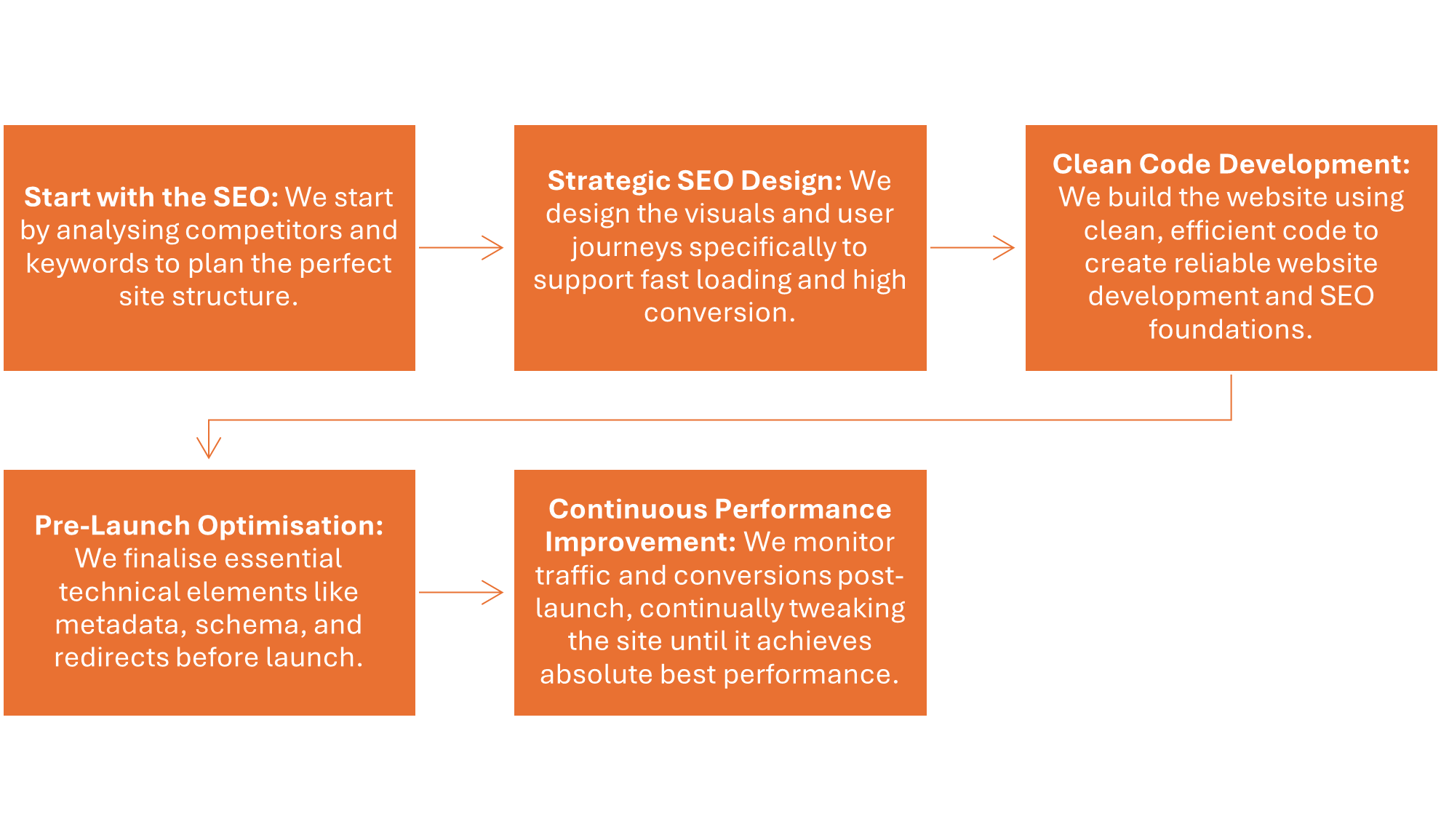
How Loop Digital Builds SEO-Friendly Websites (With Zero Headaches)
Let’s walk you through how we actually do this, in real customer language:
When Should You Consider Redesigning with SEO in Mind?
If any of these sound familiar, your website might be due for a combined SEO and design upgrade:
It loads slowly
It’s not mobile-friendly
People bounce quickly
It looks outdated
You’re not getting enquiries
Your rankings have dropped
The layout feels messy
The content is hard to read
You’re embarrassed to share the URL
If you’re nodding to more than one of these, don’t worry, you’re not alone. And more importantly, it’s fixable.
Final Thought: Your Website Deserves to Perform, Not Just Look Nice
At Loop Digital, we have witnessed the transformative power that occurs when businesses finally grasp that web design and search engine optimisation are a unified team, not two strangers operating in isolation.
Effective SEO on a confusing, badly designed website might attract traffic, but it absolutely won’t convert visitors into paying customers.
But when both disciplines are executed flawlessly? You gain an invaluable digital asset. You receive a website that works tirelessly for you 24/7, powerfully driving qualified traffic, deeply engaging visitors, and consistently turning them into loyal customers.
If you are ready to find out exactly how your current website stacks up against the competition and what steps are needed for genuine growth, we are here to help. No pressure, no confusing jargon, just honest, strategic guidance on achieving true digital success. Book your 30 minute free consultation now
Katie is our exceptional Lead Designer who possesses an innate passion for designing websites and creating captivating themes and aesthetics. Her unparalleled dedication to producing innovative solutions that address client needs and reshape user perceptions is truly commendable. Katie finds immense gratification in crafting tangible designs that leave a lasting impact. Equipped with a comprehensive university degree in Computer Management and Web-Based Studies, Katie brings a wealth of knowledge to the forefront of her role at Loop. Her educational background empowers her to leverage cutting-edge technologies and industry best practices to deliver exceptional design solutions. Katie's expertise shines through her ability to revamp websites, logos, and brands, allowing clients to showcase their business in a fresh and illuminating manner. Her keen eye for detail and creative flair breathe new life into digital assets, providing a platform for clients to shine in their respective industries. In addition to her professional pursuits, Katie's passion for baking serves as a testament to her creative nature and attention to detail. This dedication extends beyond her design work and fuels her ability to approach each project with meticulousness and care. Her ability to understand clients' unique requirements and translate them into captivating designs has garnered her praise and established her as a trusted design partner. Katie's professionalism and unwavering enthusiasm make her an invaluable asset to our team. Her expertise in website design, coupled with her dedication to delivering tangible results, sets her apart as a Lead Designer. Clients can expect nothing short of exceptional designs that elevate their brand, captivate their audience, and drive success.
Looking for your next opportunity?
Digital marketing careers
We’re always on the lookout for talented individuals to join our ever growing team. If you think you’d be a great match for Loop Digital, we’d love to hear from you.