

Posted on 07/07/2026 by Harikanth Reddy
What is an AEO strategy, and how do you implement one?
An AEO (Answer Engine Optimisation) strategy is the process of structuring content so search engines, AI-powered search experiences, and answer engines can more easily identify, understand, and surface direct answers to user queries.
While traditional SEO focuses on improving visibility within search results, AEO focuses on increasing the likelihood that your content is selected, summarised, or presented as a direct answer. When combined with SEO and GEO (Generative Engine Optimisation), it ensures your content is not just discoverable but actively used by search engines.
In this guide, we’ll break down exactly what an AEO strategy is, how it differs from SEO, and, most importantly, how to implement it in a practical, results-driven way.
Table of Contents
- How is AEO different from SEO?
- Why should you care about AEO, SEO, and GEO together?
- What are the core components of an AEO-led content strategy?
- Question-led content planning
- Structured, scannable answers
- Authority and E-E-A-T signals
- How do you find the most important AEO-style questions to answer?
- How should you structure your content to win AEO and SEO?
- How do you actually implement an AEO strategy step by step?
- Audit your existing content for question-based queries.
- Map your FAQs to search intent and geo-intent
- Rewrite or create pages with direct, structured answers
- Add schema markup
- Track performance in Google Search Console
- Iterate
- What are common AEO mistakes that hurt SEO?
- Will AEO replace SEO in the future?
- Ready to Strengthen Your SEO, AEO & GEO Strategy?
- FAQ’s
How is AEO different from SEO?
The primary difference lies in the intent of the output. Search Engine Optimisation (SEO) focuses on ranking a website within a list of results to encourage a user to click through to a page. Answer Engine Optimisation (AEO) focuses on providing the definitive, immediate answer to a query, often resulting in a “zero-click” experience where the user never leaves the search interface.
Why should you care about AEO, SEO, and GEO together?
You should care about AEO, SEO, and GEO together because each plays a different role in how your content is discovered, understood, and surfaced in modern search results.
- SEO – Improves visibility in traditional search results
- GEO – Improves visibility in answer engines and AI-generated responses
- AEO – Improves the likelihood of being referenced, cited, or surfaced by generative AI platforms
Together, they ensure your content is visible across traditional search results, local intent queries, and AI-powered answer engines. Your content doesn’t just rank; it gets selected, extracted, and presented as the answer users see first.
This combined approach means your content isn’t just discoverable; it’s used by search engines to answer real questions.
What are the core components of an AEO-led content strategy?
The three core components of an AEO-led content strategy are:
- Question-led content planning
- Structured, scannable answers
- Authority and E-E-A-T signals
The key pillars include:
Question-led content planning
This means you start with the questions your audience is actually asking, not just the keywords you want to rank for. This shifts your content from being keyword-stuffed to being genuinely useful, which is what both users and AI systems respond to.
Structured, scannable answers
These are about format as much as content. Short paragraphs, clear headings, bullet points, and a direct answer in the first two or three sentences of every section. AI systems are essentially skimming your content for the clearest, most concise answer to a query, so you need to make it dead easy for them to find it.
Authority and E-E-A-T signals
E-E-A-T signals (Experience, Expertise, Authoritativeness, and Trustworthiness) are what separate content that gets cited from content that just exists. This means having real authors, credible sources, accurate information, and a track record of publishing quality content
A strong AEO-first content strategy ensures your content is both readable for humans and extractable for machines.
Entity Optimisation and Brand Consistency
Modern search engines and AI systems increasingly rely on entity understanding rather than simple keyword matching. An entity can be a business, person, product, organisation, or location that search engines can confidently identify and associate with specific topics.
For example, Google and AI-powered search tools should understand that Loop Digital is a digital marketing agency specialising in SEO, PPC, web design, and AI search optimisation. The clearer those associations become across the web, the more likely your content is to be surfaced for relevant searches and AI-generated answers.
Strong entity signals include:
- Consistent business information across your website and directories
- Organisation Schema markup
- Author profiles with relevant expertise
- Google Business Profile optimisation
- Industry citations and mentions
- Digital PR coverage
- Consistent branding across social media platforms
Entity optimisation sits at the intersection of SEO, AEO, and GEO. While SEO helps search engines find your content and AEO helps them understand your answers, entity optimisation helps them understand who is providing those answers.
How do you find the most important AEO-style questions to answer?
The best place to start is Google itself. “People Also Ask” (PAA) boxes are essentially a live feed of the questions your audience is typing into search, and they update constantly based on real search behaviour. If you’re not mining PAA boxes for content ideas, you’re missing one of the most direct signals available to you.
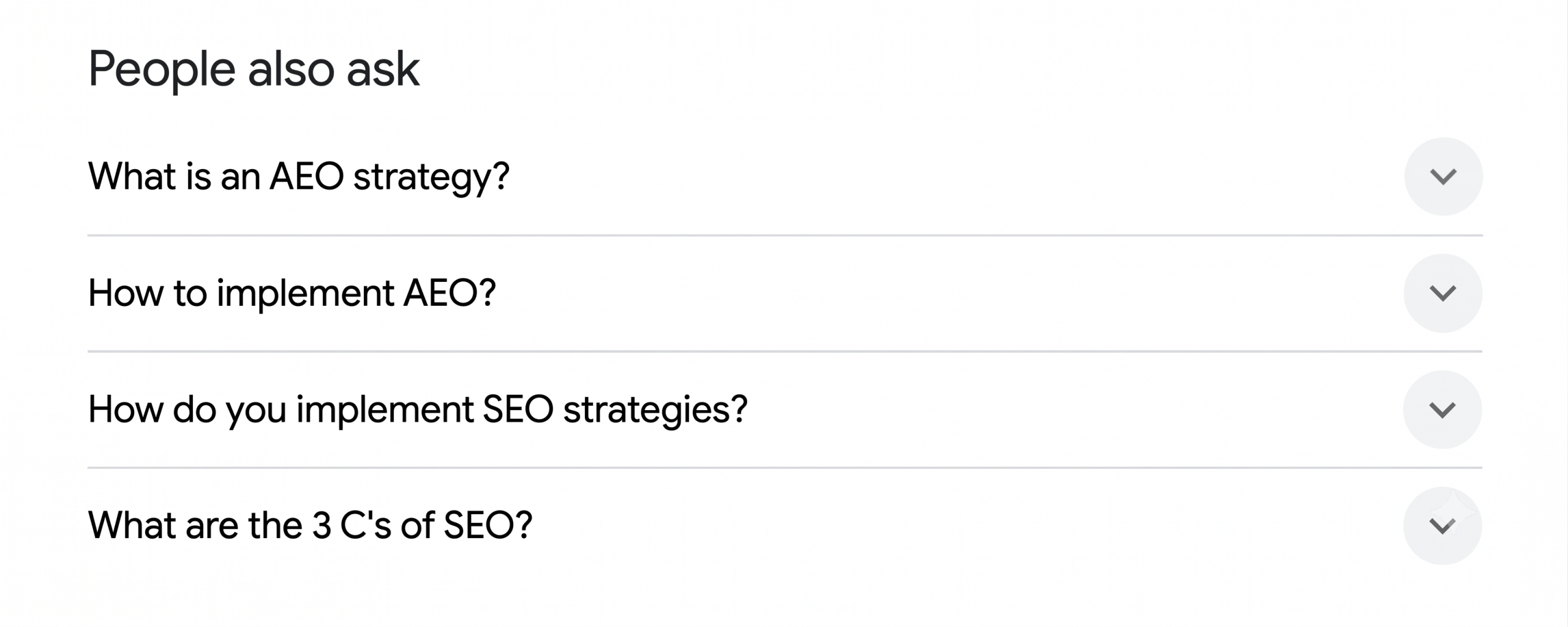
Start with:
- “People Also Ask” sections in search results
- Tools like AnswerThePublic or SEO platforms with question filters
- Google Search Console queries that include question formats
Once you have a list, cluster questions by:
- Intent (informational vs transactional)
- Topic relevance
- Location signals (for GEO alignment)
Don’t overlook your own Google Search Console data either. Filter your queries by those that contain words like “what”, “how”, “why”, “where” and “best”. These are your AEO goldmines. If Google is already sending traffic to your site for question-based queries, that’s a clear signal that you have existing authority you can build on.
Once you’ve got your questions, cluster them by intent:
- Informational questions (“What is AEO?”) need educational, clear answers.
- Transactional questions (“Best AEO strategy for B2B”) need a mix of education and commercial value.
- GEO-flavoured questions (“AEO strategy for businesses in Manchester”) need a local context layered in.
Getting the intent right is what separates content that converts from content that just gets read.
How should you structure your content to win AEO and SEO?
To win at both AEO and SEO, your content should answer questions immediately, then provide supporting detail in a clear, structured format.
Follow this structure:
- Use H1 for the main query and H2–H3 for supporting questions
- Provide a direct answer within the first 2–3 sentences
- Expand with examples, explanations, or bullet points
- Keep paragraphs short and easy to scan
This format helps search engines extract your content for featured snippets while also improving readability and engagement for users.
Think of it like this: the top of your content should work as a summary, while the rest builds authority. This format increases your chances of being featured in both SERPs and AI-generated answers. This structure also directly supports your SEO performance. Google’s algorithms increasingly favour content that’s easy to understand and well-organised. AEO-friendly structure and SEO-friendly structure are, for the most part, the same thing, which is exactly why working on one improves the other.
How do you actually implement an AEO strategy step by step?
Implementing an AEO strategy is about refining what you already have and building with intent going forward.
A practical workflow looks like this:
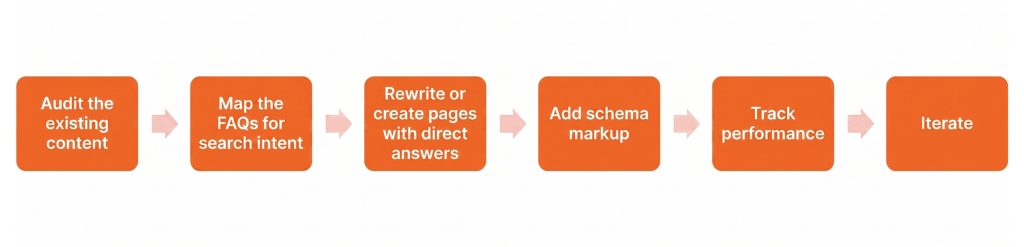
Audit your existing content for question-based queries.
Go into Google Search Console and identify which pages are already receiving impressions or clicks for questions. These are your quick wins, pages that already have some authority and just need to be restructured or expanded to become AEO-friendly.
Map your FAQs to search intent and geo-intent.
For each question you want to answer, identify whether the intent is informational, transactional, or local. This determines how you write the answer and what additional signals you layer in.
Rewrite or create pages with direct, structured answers.
Use the heading hierarchy (H1 for the main question, H2/H3 for sub-questions), lead each section with the answer, keep paragraphs short, and use lists where appropriate.
Add schema markup.
Implement structured data that accurately reflects the content type, such as Article, HowTo, Organisation, LocalBusiness, and FAQPage where appropriate. While structured data does not guarantee AI visibility or rich results, it can help search engines better understand and categorise your content.
Track performance in Google Search Console.
Monitor your impressions for question-format queries, track which pages earn featured snippets, and look for improvements in click-through rates over time.
Iterate.
AEO is not a set-it-and-forget-it strategy. Revisit your content regularly, update answers when information changes, and keep expanding your question coverage as new queries emerge.
This step-by-step approach ensures your AEO strategy implementation is measurable and scalable.
Also read our guide on: Google Search Console
How Voice Search Drives Your AEO Strategy
While voice search helped popularise answer-focused optimisation, modern AEO extends far beyond smart speakers. Today, users increasingly ask questions through AI-powered search experiences such as ChatGPT, Gemini, Perplexity, and Microsoft Copilot. Whether the answer is spoken aloud or displayed on a screen, the goal remains the same: provide the clearest, most useful response to a user’s question.
When someone asks a voice assistant a question, they aren’t looking for a page of ten blue links; they want a single, definitive answer. This makes voice search optimisation a critical extension of your broader AEO content framework.
The Mechanics of Voice-Driven AEO
To capture voice search queries, your content must match how people actually speak, not just how they type. This requires a slight shift in your writing mechanics:
- Target Conversational, Long-Tail Keywords: Instead of optimising for “AEO strategy B2B”, optimise for the complete spoken question: “What is the best AEO strategy for B2B businesses?”
- Write for the Ear (Readability & Pronunciation): Voice assistants read your content out loud. Keep sentences punchy, avoid dense industry jargon where possible, and ensure the text sounds natural when spoken. If a virtual assistant struggles to parse or smoothly pronounce a paragraph, it will skip it in favour of a simpler competitor.
- The Inverted Pyramid for Audio: Just like AI search engines, voice engines look for “answer-first” density. Lead your sections with a concise 40–60-word summary that can be easily spoken by an assistant in under 10 seconds, then follow up with your deeper technical data for screen-using readers.
By aligning your AEO strategy with conversational natural language processing (NLP), you ensure your brand isn’t just readable on a screen; it’s the literal voice answering your audience’s questions.
What are common AEO mistakes that hurt SEO?
The most common AEO mistakes include oversimplifying answers, ignoring authority signals, and failing to align content with search intent.
Key mistakes to avoid:
- Writing short answers without meaningful depth
- Ignoring E-E-A-T signals like credibility and authorship
- Overusing AI-generated content without editing or validation
- Missing local intent in geo-targeted content
- Failing to structure content for easy extraction
A successful AEO strategy balances concise answers with detailed, trustworthy information.
What Does an AEO Strategy Look Like for B2B Businesses?
An AEO strategy for B2B businesses differs slightly from consumer-focused optimisation because buyers typically conduct more research, involve multiple stakeholders, and ask more detailed questions before making a purchasing decision.
Rather than targeting high-volume keywords alone, B2B AEO focuses on answering the questions prospects ask throughout the buying journey.
Examples include:
- What is the best CRM for manufacturing companies?
- How much does outsourced SEO cost?
- What should I look for in a digital marketing agency?
- Is PPC or SEO better for lead generation?
For B2B organisations, effective AEO content often includes:
- Detailed buying guides
- Service comparison pages
- Industry-specific FAQs
- Case studies
- Pricing and ROI content
- Thought leadership articles
By answering these questions clearly and authoritatively, B2B businesses can increase visibility in traditional search, AI-generated answers, and research-driven buying journeys.
Will AEO replace SEO in the future?
No, AEO will not replace SEO, it will evolve alongside it.
SEO remains essential for ranking and discoverability, while AEO focuses on how content is selected and displayed as direct answers. GEO adds another layer by targeting location-based intent.
Together, these approaches form a complete search strategy where:
- SEO drives visibility
- GEO captures local relevance
- AEO secures answer placement
The future of search is not about replacing SEO, but enhancing it with AEO and GEO.
Key Takeaways
- AEO focuses on structuring content so AI search engines and assistants can directly extract and display your responses.
- AEO works best when combined with SEO and GEO.
- Question-led content is the foundation of a strong AEO strategy.
- Structure is critical for both users and search engines.
- Strong E-E-A-T signals can increase the perceived credibility and trustworthiness of your content, making it more likely to be considered for prominent search features and AI-generated responses.
- Your existing content is often your biggest opportunity.
- Schema and technical SEO support AEO performance.
- AEO is an ongoing process, not a one-time fix.
- Common mistakes come from over-simplifying content.
- AEO is an evolution of SEO and GEO, and businesses that integrate all three will have a clear competitive advantage.
Ready to Strengthen Your SEO, AEO & GEO Strategy?
If your website isn’t showing up where it matters, whether in search rankings, AI-generated answers, or local results, it’s time to take a closer look at your strategy. Modern visibility isn’t just about SEO anymore. It’s about how well your content performs across SEO, AEO, and GEO together.
At Loop Digital, we help businesses identify gaps, refine their content, and build strategies that actually align with how people search today.
Start by getting your current performance checked, see where you’re missing opportunities and where you can gain quick wins. From there, book a consultation to explore a tailored approach designed around your industry, audience, and growth goals.
Want to stay ahead of constant search changes? Subscribe to our newsletter for insights, updates, and strategies that keep you one step ahead of the market.
FAQs
1. What is considered an AEO-friendly format?
An AEO-friendly format includes clear headings, direct answers at the top, and structured content like bullet points and short paragraphs. It should be easy for both users and search engines to scan and extract information.
2. How long should an AEO answer be?
There is no universally ideal answer length. In many cases, concise answers work well because they are easier for search engines and AI systems to understand, but the appropriate length depends on the complexity of the question and the user’s intent.
3. Do you need AI-generated content to win at AEO?
No, but AI can assist with research and structuring. What matters most is clarity, accuracy, and authority, regardless of how the content is created.
4. Can small businesses afford an AEO + GEO strategy?
Yes, because much of AEO and GEO is about optimisation rather than scale. With the right structure and targeting, smaller businesses can compete effectively in answer-driven search.
5. How do you measure the success of an AEO strategy?
Success in an AEO strategy is measured by visibility in featured snippets, AI-generated answers, and “People Also Ask” results. You should also track increases in impressions, click-through rates, and question-based query performance in tools like Google Search Console.
6. What types of content work best for an AEO-first content strategy?
Content that directly answers questions performs best, including FAQs, how-to guides, comparison pages, and explainer articles. The key is structuring content clearly so search engines can easily extract and present it as an answer.
7. Is AEO important for B2B businesses?
Yes, an AEO strategy for B2B is increasingly important because decision-makers often search using detailed, question-led queries. Providing clear, authoritative answers helps position your brand as a trusted source early in the buying journey.
8. How often should you update your AEO content strategy?
You should review and update your AEO content strategy regularly, typically every 3–6 months. This ensures your answers remain accurate, competitive, and aligned with evolving search behaviour and AI-driven results.
Looking for your next opportunity?
Digital marketing careers
We’re always on the lookout for talented individuals to join our ever growing team. If you think you’d be a great match for Loop Digital, we’d love to hear from you.








Join 300+ business owners getting weekly growth strategies - subscribe now.
"*" indicates required fields