

Posted on 15/04/2026 by Harikanth Reddy
How Do AI Search Engines Like ChatGPT and Google AI Overviews Work?
AI search engines use Large Language Models (LLMs) to understand the context of your query rather than just matching keywords. Instead of providing a list of blue links for you to click, they “read” through top-ranking web content, synthesise the information, and generate a conversational summary. Essentially, they act as a digital librarian that summarises the books for you, rather than just pointing you to the shelf.
If you’ve typed a question into Google recently and been met with a paragraph of AI-generated text before you’ve even seen a single link, you’ve already experienced the shift first-hand. AI search is no longer a future concept; it’s the present reality. And for UK businesses trying to stay visible online and keep those enquiry forms ticking, it’s something worth genuinely understanding.
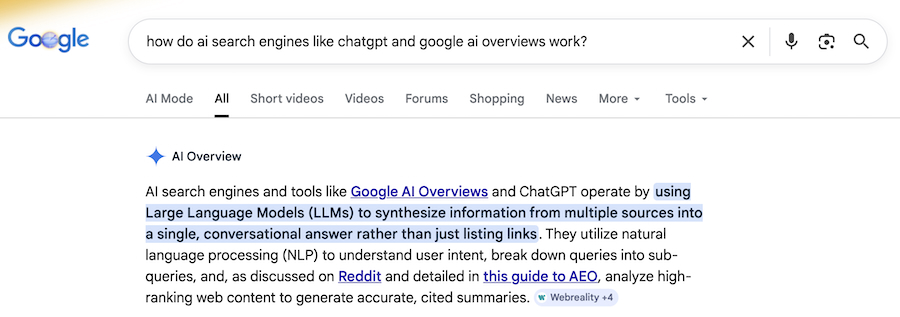
To stay visible and keep enquiry forms ticking, businesses must evolve beyond traditional SEO. This blog is part of our series on helping you dominate the “AI SERP” through two key strategies:
- Generative Engine Optimisation (GEO): Optimising your content so LLMs cite you as a primary source.
- Answer Engine Optimisation (AEO): Crafting direct, authoritative answers to specific customer questions.
You no longer just want to be “on the page”; you want to be the source the AI trusts. Transitioning to a cluster-based content strategy is the best way to ensure your business remains the go-to answer in your industry.
So, let’s break it all down. We’re talking about what AI search engines actually are, how they work under the bonnet, how tools like ChatGPT Search and Google AI Overviews differ from each other, and, most importantly, what this means for your visibility and leads.
What Are AI Search Engines?
An AI search engine is an information retrieval system that integrates Large Language Models (LLMs) and Natural Language Processing (NLP) to provide synthesised, generative responses to user queries.
Unlike traditional search engines that rely on keyword indexing and link-based ranking, these systems utilise Semantic Search to interpret the context and intent behind a query. They employ Retrieval-Augmented Generation (RAG) to extract data from various web sources, process the unstructured information, and output a singular, coherent response in natural language.
AI-powered search engines include tools you’re likely already familiar with: ChatGPT Search, Google AI Overviews (powered by Gemini), Microsoft Copilot (integrated into Bing), and Perplexity AI.
How Does AI Search Work? The Core Mechanics
Both ChatGPT and Google AI Overviews rely on large language models. These systems are trained on vast amounts of data to understand the nuances of human language. When you enter a query, the AI doesn’t just look for “matching words”. It uses semantic search to understand the intent behind your question.
It Starts With Understanding Your Intent
The first thing an AI search engine does is try to understand what you actually mean, not just the words you’ve used. This is called natural language processing (NLP), and it’s the reason you can now type “What’s a good running shoe for dodgy knees?” and get a genuinely useful response, rather than results that just match the phrase “running shoe”.
Traditional search engines were built around keywords. Type in the right words, and you’ll surface the right pages. AI-powered search engines go deeper; they interpret the context, the intent, and even the nuance behind your query. They understand that “how do I get more leads from my website” and “increase website conversions” are essentially asking the same thing, just phrased differently.
The Role of Large Language Models (LLMs)
At the heart of every generative AI search engine is a large language model. These models are trained on vast amounts of text, books, websites, articles, and academic papers, and in doing so, they develop an impressive ability to understand language, context, and how ideas connect.
When you submit a query, the LLM isn’t simply scanning for keyword matches. It’s applying a kind of reasoning, weighing up what the question is really asking, drawing on its training, and constructing a coherent, relevant response.
Retrieval-Augmented Generation (RAG): How AI Stays Current
Retrieval-Augmented Generation (RAG) is an architectural framework that enhances the accuracy and reliability of generative AI models by enabling them to access and incorporate data from external, authoritative sources outside of their original training data.
This is the bit that makes AI search genuinely useful for current, real-world queries, and it’s called Retrieval-Augmented Generation, or RAG.
To understand how it works, we can break the process down into three distinct steps:
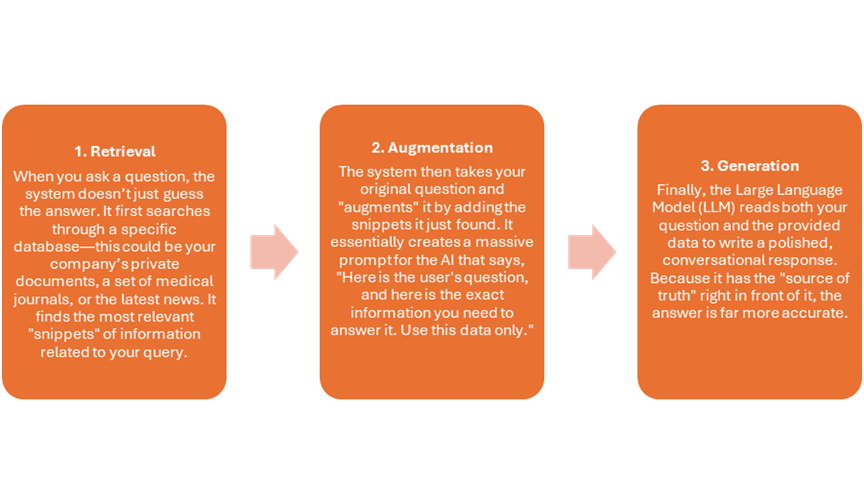
The RAG Framework (Source: Loop Digital)
Vector Embeddings and Semantic Search
Modern AI search converts your query and web content into numerical “vectors” that map meaning rather than just text. This uses semantic relationships to understand the intent behind your query. Consequently, the engine identifies content that is conceptually relevant to your question, even if the specific vocabulary differs. By focusing on context and mathematical patterns, AI bridges the gap between how humans ask questions and how information is stored, delivering results based on relevance instead of literal word-for-word matches.
How ChatGPT Search Works
ChatGPT Search, rolled out globally by OpenAI, operates as a hybrid between a conversational AI assistant and a real-time search tool. When you ask it a question, it can draw on its broad training, retrieve live results from across the web via Bing and other sources, and weave those together into a flowing, cited response.
What makes ChatGPT Search feel different from a traditional search engine is the dialogue. You can refine your question, ask follow-ups, and drill down into specifics, and crucially, it remembers the context of your conversation. That’s something a list of links simply cannot do.
Internally, when it receives your query, it often rephrases or expands it before searching, adding related terms, recognising entities, and clarifying ambiguities to improve the quality of the retrieval. It’s effectively running a smarter search than most users would know how to run themselves.
ChatGPT Search also tends to produce longer, more exploratory answers for complex queries. If you ask something open-ended like “What marketing strategy should a small business focus on?’’, you’ll get a structured, thoughtful response, not a list of blue links.
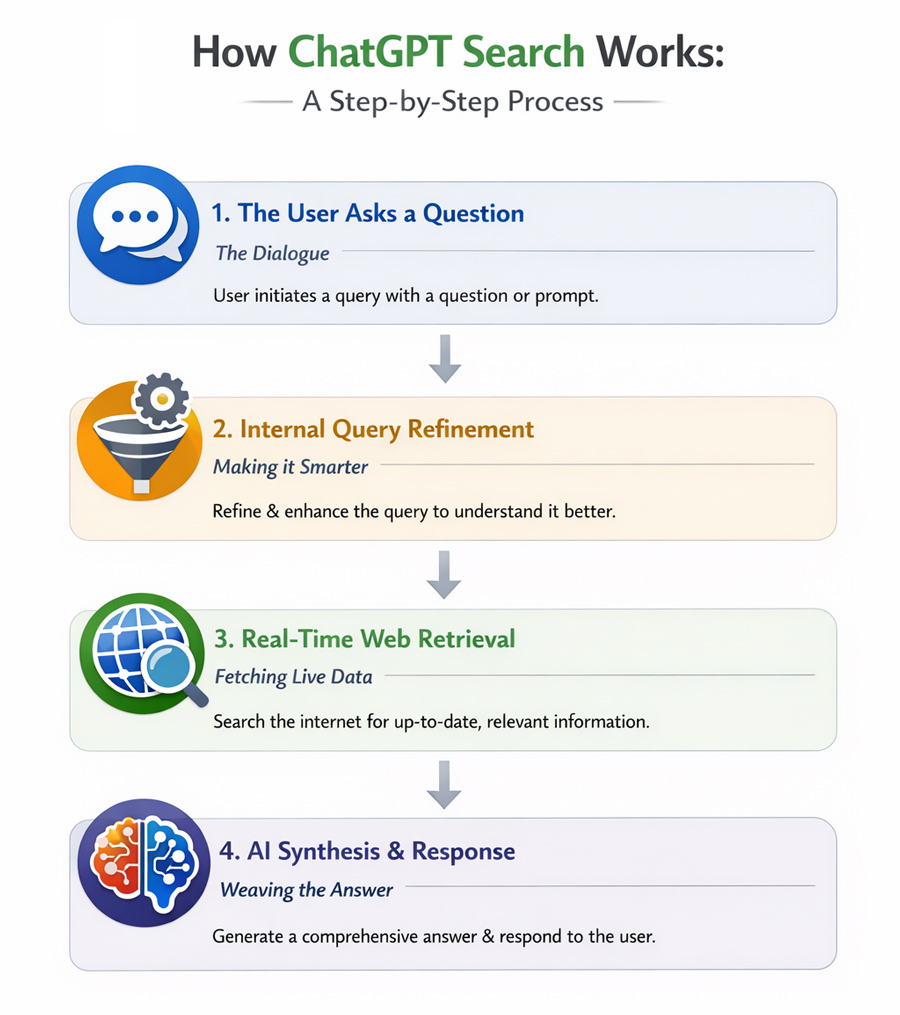
How Google AI Overviews Work
Google AI Overviews are perhaps the most visible change for everyday UK search users right now. They appear at the top of Google’s results page, above the organic rankings, and provide a generated summary answer to your query, complete with citations to source pages.
They run on Google’s Gemini AI models and tap into Google’s search index, one of the most comprehensive in existence. When you search for something, Google doesn’t just run the traditional ranking algorithm. Gemini also analyses your query and pulls together a synthesised response from multiple trusted sources within the index.
Unlike a standalone AI chatbot, Google AI Overviews sit within the traditional Google Search interface. So users still see organic results below the overview, but, and this is the important bit for businesses, a significant portion of users get enough from the overview that they don’t scroll further or click through to any website at all.
AI Search vs Traditional Search: What’s Actually Different?
| How it Works | Crawls and indexes pages, then ranks them based on keywords, backlinks, and performance. | Uses Large Language Models (LLMs) to understand intent and retrieve specific data snippets. |
| User Experience | The user clicks multiple websites to find a complete answer. | The user often gets the full answer directly on the search page (Zero-Click). |
| Success Metric | Ranking & Clicks: Being in the top 3 blue links to drive website traffic. | Citation & Authority: Being the trusted source, the AI “quotes” in its summary. |
| Content Focus | Optimised for keywords, technical SEO, and specific metadata. | Optimised for clarity, structure, and expert insight that an AI can easily “pluck.” |
| Search Intent | Best for navigational queries (e.g., “Loop Digital website”). | Best for complex, informational, or “how-to” queries that require an explanation. |
Why “Generative AI Search Engines” Are Changing Search Behaviour
Generative AI Search Engines are search platforms that use Large Language Models (LLMs) to understand the intent behind a user’s query and generate a cohesive, conversational response.
There’s a broader behavioural shift happening here, and it’s moving faster than most people realise.
People are increasingly treating search engines as conversational assistants rather than information directories. Queries are getting longer, more complex, and more question-based. Users expect nuanced answers, not just links to pages that might contain relevant content somewhere within them.
Tools like ChatGPT, Perplexity, and Google’s AI Mode are actively encouraging this behaviour. They’re designed for conversation, for follow-up, for refinement. And once users experience that kind of interaction, going back to ten blue links feels like a step backwards.
What does this mean for Your Visibility and Leads?
Zero-Click Is Becoming Normal for Many Query Types
When Google AI Overviews or ChatGPT Search answer a question directly in the interface, a meaningful portion of users simply don’t click through to any website. They got what they needed. This is the zero-click and AI visibility outcome, and it’s now a consistent reality for informational queries in particular.
Being Cited Is the New Ranking
If AI search engines are synthesising answers from multiple sources, the goal isn’t only to rank on page one anymore. It’s to be one of the sources the AI draws from and cites within its generated answer.
This is where Answer Engine Optimisation becomes a genuinely important part of your digital strategy. Rather than optimising purely for search rankings, you’re also optimising for citation, making your content the kind of trustworthy, clearly structured, directly useful resource that AI systems choose to reference.
Content Authority and Clarity Matter More Than Ever
AI language models are surprisingly good at distinguishing between content that demonstrates genuine expertise and content that’s been engineered to tick keyword boxes. Content that tends to get cited in AI-generated answers is clear, direct, well-organised, and genuinely informative, and has become an integral part of content marketing. It answers specific questions in plain language. It’s structured in a way, with logical headings, concise definitions, and practical information, that makes it easy to extract a meaningful answer from. If your site content is built primarily around keyword density or thin pages, the shift towards AI search is likely to reduce rather than increase your visibility.
Commercial and Transactional Intent Still Drives Clicks
Not every search ends in a zero-click outcome. Queries with commercial intent, “digital marketing agency Northampton,” “best accountant for small businesses,” “compare X vs Y”, still tend to result in users clicking through to explore options, request quotes, or make contact.
This is genuinely good news for service businesses. If your customers are searching with buying intent, they’re likely to visit your website still. But how your business is described, reviewed, and represented across the web shapes how AI search tools understand and present you, even to users who are ready to buy.
Local search is particularly worth watching here. AI Overviews are already appearing in a substantial proportion of local business searches, meaning your Google Business Profile, your on-site content, and your reviews all feed into how AI systems represent your business to local searchers.
The Bottom Line
AI search engines, whether that’s ChatGPT Search, Google AI Overviews, or the growing range of AI-powered search tools, work by understanding the intent behind queries, retrieving relevant content, and generating direct, synthesised answers. They don’t just match keywords. They reason, contextualise, and cite.
For UK businesses, the implications are real, and they’re already here. Zero-click outcomes are increasing for informational queries. Being cited in AI-generated answers is becoming as commercially important as ranking on page one. And the content that earns that visibility, clear, structured, genuinely authoritative content, is increasingly different from the content strategies that dominated traditional search.
The good news? This is absolutely manageable if you approach it strategically and start thinking about it now, rather than in two years when the shift has fully bedded in.
Ready to Stay Visible in the Age of AI Search?
Understanding how AI search engines work is one thing. Making sure your business actually shows up in them is another, and that’s where we come in.
At Loop Digital, we help UK businesses stay visible, relevant, and competitive across traditional search, AI Overviews, and the growing world of AI-powered discovery. Whether it’s building the foundations of local SEO that underpin everything, structuring your content for Answer Engine Optimisation (AEO), or positioning your brand for Generative Engine Optimisation (GEO), we bring it all together into one joined-up strategy designed to generate real leads, not just rankings.
Our industry updates are where we share the developments that actually affect UK businesses, no noise, no clickbait, just the insights that help you make smarter decisions. Check in regularly, or subscribe to our community and get them straight to your inbox.
Or, if you’d rather just have a conversation about where you stand and what to do next, book a free 30-minute consultation with one of our team. No hard sell, just a straight-talking chat about your business and what’s possible.
Frequently Asked Questions
1. What is the difference between AI search and traditional search?
Traditional search returns a ranked list of links and relies on the user to read and synthesise the information. AI search interprets the intent behind a query, retrieves relevant content, and generates a direct, conversational answer, often with citations. The shift means visibility now depends not just on ranking, but on being cited and trusted as a source within AI-generated responses.
2. Are AI search engines replacing Google?
Not replacing, but meaningfully changing it. Google remains the dominant search platform, and Google itself has integrated AI heavily into its search experience through AI Overviews and AI Mode. Other tools like ChatGPT Search and Perplexity are growing in usage, particularly among younger users and for complex research queries. Most users are currently using AI tools alongside traditional search, not instead of it.
3. Does my website still need SEO if AI search is growing?
Yes, and significantly. Strong SEO foundations remain essential. Technical performance, content quality, authority signals, and relevance all feed into both traditional rankings and AI search visibility. AI search doesn’t make SEO redundant; it raises the bar for what good content looks like, and adds additional requirements around clarity, structure, and being cited as a trusted source.
4. Why does my website traffic drop when AI Overviews appear?
When an AI Overview provides a satisfying answer at the top of the search results page, some users don’t need to click through to any website. This is the zero-click effect. It tends to affect informational queries more than commercial or transactional ones. The response isn’t to stop creating informational content; it’s to ensure that the content is structured in a way that earns citation within the AI Overview itself, keeping your brand visible even without the click.
5. Can small businesses compete in AI search?
Genuinely, yes, and in some respects, more easily than in traditional SEO. AI systems prioritise content that is clear, specific, and directly useful. A small business with deep expertise in its field and well-structured content can earn AI citations alongside, or even ahead of, much larger competitors. Early adoption of AI-focused content strategies gives smaller businesses a real opportunity to establish authority before the competition catches up.
6. How does voice search connect to AI search engines?
Voice search and AI search are increasingly intertwined. As AI search becomes more conversational, voice becomes a more natural interface. People ask questions out loud in the same way they’d ask a knowledgeable person, conversationally, with full sentences and real context. Content that’s written to directly answer specific questions, in plain and natural language, tends to perform well across both voice and AI search.
7. What is retrieval-augmented generation (RAG) and why does it matter?
RAG is the technical process that allows AI search tools to stay current. Rather than relying solely on training data (which could be many months old), the AI retrieves fresh web content relevant to your query, feeds it into the language model, and generates a response that blends current information with broader knowledge. For businesses, it matters because it means newly published, well-structured content can be retrieved and cited; you don’t need to have been on the web for years to earn AI visibility.
Looking for your next opportunity?
Digital marketing careers
We’re always on the lookout for talented individuals to join our ever growing team. If you think you’d be a great match for Loop Digital, we’d love to hear from you.








Join 300+ business owners getting weekly growth strategies - subscribe now.
"*" indicates required fields