What the Biggest Google Ranking Updates of 2025 Mean for Businesses
Read Time: 11 minutes
2025 brought four major Google ranking updates: two broad core updates in March and June, a focused spam cleanup in August, and another core update that rolled through December into the new year. If your rankings shifted, your phone stopped ringing, or you’re wondering whether SEO still works, you’re not imagining it.
Each update took weeks to fully settle. That’s normal. Rankings wobble during rollouts, which is why checking your performance on day three of a two-week update rarely tells you anything useful.
What Google Means by a “Core Update”
A core update is a broad reassessment of content quality across the entire index.
Google is always trying to show the most helpful result. A core update means it’s refined how it measures “helpful.” Pages that were borderline before might drop. Pages that better match what searchers actually need might rise, even if they haven’t changed a thing.
Businesses that did nothing “wrong” can lose rankings. Competitors who’ve been invisible suddenly appear. And it takes time to settle because Google is recalculating billions of pages.
What Local Businesses Often Misunderstand
When rankings change quickly, the normal reactions are:
“SEO is broken.”
“Google has penalised us.”
“We need to rewrite the whole website this week.”
More often, what’s happening is simpler:
Google changed what it rewards.
A competitor’s page is a clearer, more complete answer.
Your page still “covers it”, but it doesn’t prove it when it comes to experience, credibility, and outcomes.
Quick Reality Check
Don’t panic-edit your entire website the moment rankings shift
Check Search Console trends over weeks, not daily rank tracking tools
One keyword dropping doesn’t mean your whole strategy failed
For local businesses, this meant leads could drop even when Search Console reported stable impressions and rankings.
How to Make Every Click Count?
Build conversion-ready pages, instead of just ranking-ready pages
Fast, frictionless contact options above the fold (click-to-call, simple forms, live chat if you can staff it)
Strong first-screen messaging that immediately confirms they’re in the right place
Easy booking, quoting, or enquiry process.
Strengthen deep pages, not just your homepage. Google increasingly cited specific service pages, blog posts, and FAQ content in AI Mode and featured snippets. If your deep pages don’t answer the question fully, you lose the click and the visibility.
August 2025 Spam Update: Google’s Cleanup Operation
Rolled out: 26 August – 22 September 2025
Unlike core updates, spam updates target specific manipulative tactics. August’s core update rollout lasted nearly a month and focused on reducing “fake wins” such as rankings achieved through volume, duplication, or outdated tricks rather than genuinely helpful content.
Why Legitimate Businesses Can Benefit
If competitors relied on shortcuts, a spam update can remove their advantage.
That means cleaner, more useful sites sometimes rise simply because the results become less polluted.
Common Targets
Mass-produced near-identical pages, with the same content, but swapped regional names
Low-quality link tactics
Thin location pages are made for rankings rather than customers
Site reputation abuse patterns, where low-quality content tries to piggyback on a domain’s authority, are only relevant in certain cases, but worth checking if you’ve ever “bolted on” low-quality sections
Quick Self-Audit
Do you have duplicate pages that say essentially the same thing with minor location swaps?
Are your blog posts genuinely helping customers make decisions, or are they keyword exercises?
Are you still relying on old SEO tactics and tricks rather than clarity, proof and content quality?
In our August update, we discussed the wider point on how discovery is shifting fast, and businesses need to adapt with substance rather than gimmicks.
December 2025 Core Update: AI-First Search
Rolled out: 11 December – 29 December 2025
December core update was the clearest signal of where Google is heading: away from traditional SERP and blue-link reliance and towards AI-led experiences.
As explained in our December 2025 industry update, this wasn’t just another algorithm tweak; it marked the acceleration of Google’s shift away from ten blue links toward conversational, answer-first search results.
What This Means In Practice
More answers happen without a click.
So your goal becomes:
Be the best answer (clear, helpful, structured)
Be the most trusted choice (proof, reputation, authority)
Be easiest to contact when someone is ready (no friction)
What to Build Now: Trust and Decision-Support Content
Service pages that remove uncertainty (process, timelines, pricing guidance)
FAQs that match real objections
Comparisons: “Do I need X or Y?”
What-to-expect pages that calm the customer down
This is also AEO (answer engine optimisation), which becomes part of modern SEO in a much more practical way. AEO helps structure helpful content so AI-led systems can understand it properly. If you don’t yet have an AEO programme, it usually sits naturally within a broader SEO services plan.
Strengthen Brand Trust Signals Across Every Touchpoint
Consistent business information (name, address, phone number, opening hours) on your website, Google Business Profile, and directories
Recent, genuine reviews that address specific services
Proof you’re a real business serving real customers (case studies, testimonials, photos, accreditations)
Create content that helps people decide, not just understand. FAQs that address objections. Service comparisons that acknowledge alternatives. Pricing guidance (even ballpark ranges help). Timelines and expectations for what happens after someone contacts you.
Search intent in 2025 isn’t just “find information.” It’s “find the right provider and feel confident contacting them.” If your content stops at information, you lose.
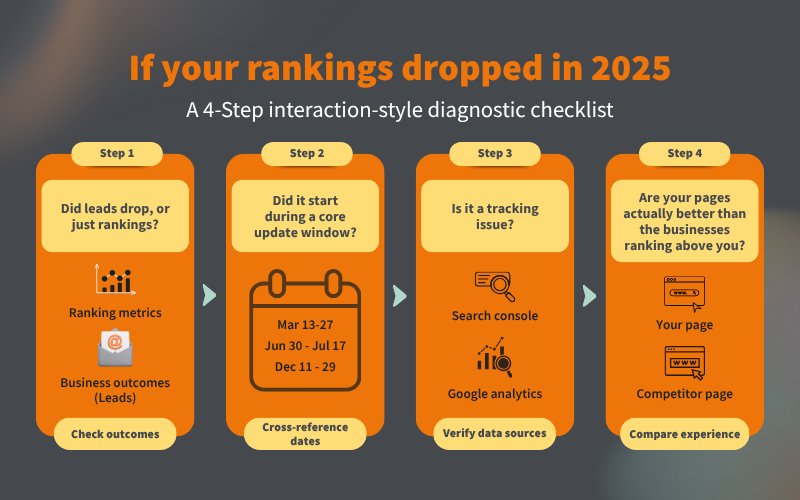
If Your Rankings Dropped in 2025
Here’s a decision checklist to work through before you panic or hire someone who promises a quick fix.
Step 1: Did leads drop, or just rankings?
Check your actual business outcomes. If your phone’s still ringing, enquiries are steady, and you’re winning the same quality of work, the ranking drop might not matter. It might even be measurement noise.
Focus your energy on conversion rate optimisation and lead quality. Sometimes rankings drop because Google decided to show a different type of result, but your actual customers are still finding you.
Step 2: Did it start during a core update window?
Cross-reference your traffic drop with the timeline of the major core updates.
If your decline started 13 – 27 March, 30 June – 17 July, or 11 – 29 December, you’re likely caught in a core update reassessment. That’s fixable, but it requires improving content quality and trust signals, not emergency technical tweaks.
Step 3: Is it a tracking issue?
March and September both saw significant disruptions to rank tracking tools and Search Console reporting. Check multiple data sources such as – Search Console, Google Analytics, actual phone calls and form submissions.
If the tools disagree wildly, trust the lead data.
Step 4: Are your pages actually better than the businesses ranking above you?
View your top competitors’ pages as a customer. Forget keyword density, instead, ask:
Is their service clearer than yours?
Do they make it easier to contact them?
Do they provide more proof they’re credible?
Would you choose them over you?
If the answer is yes, that’s your roadmap. Google didn’t penalise you, it prioritised businesses doing a better job of serving searchers.
Does Local SEO Still Work If Google Is Going AI-First?
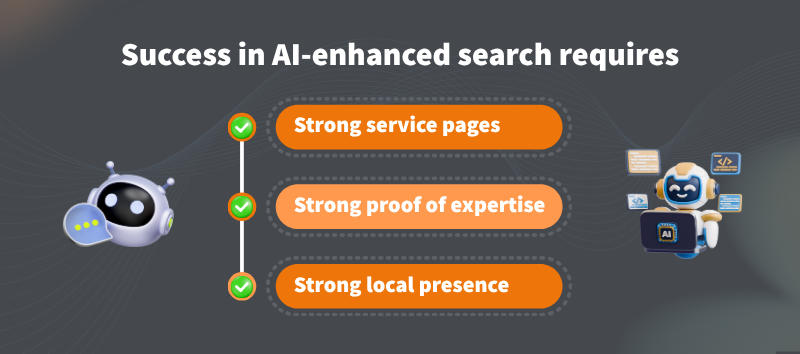
Yes. Local intent is resilient. When someone searches for “solicitor near me” or “SEO agency in Northampton,” they need a real provider in their area who can help them now. AI Mode doesn’t replace that; it just changes how visibility happens.
The difference now is that weak content gets filtered out faster, and trust signals matter more.
Note that local SEO showed surprising resilience to Google’s update, even as broader organic traffic patterns shifted. Businesses with clear service offerings, active Google Business Profiles, and decision-focused content maintained visibility.
The fundamentals work. But the margin for mediocrity has disappeared.
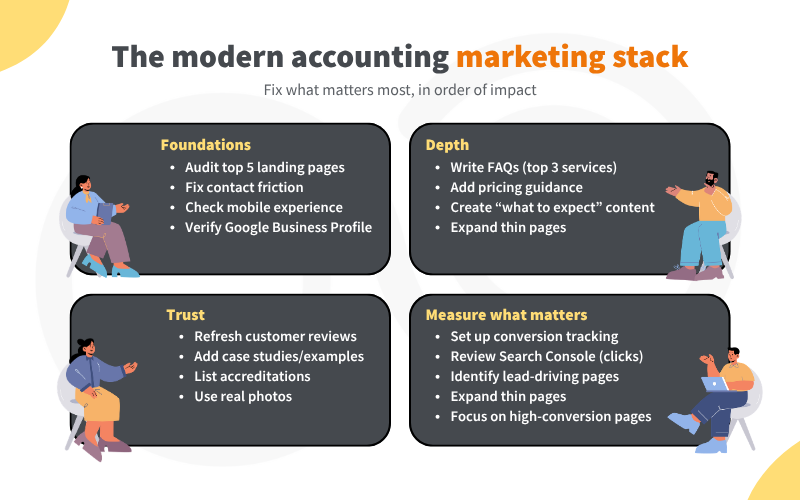
Action Plan In Response to 2025’s Core Updates
You don’t need to rebuild your entire web presence. You need to fix what matters most, in order of impact.
1. Foundations – make it easy to convert
Audit your top 5 landing pages for clarity – do they explain the service in the first paragraph?
Fix contact friction, such as one-click phone calls, simple forms, and visible contact details
Check mobile experience (most local searches happen on phones)
Verify your Google Business Profile is complete and accurate
A quick website audit is often the fastest way to surface the obvious issues without guesswork.
2. Trust – prove you’re credible
Add or refresh customer reviews (ask recent happy clients; respond to all reviews)
Include case studies or before/after examples on key service pages
List accreditations, certifications, and memberships prominently
Use real photos of your team, your work, your premises (stock photos don’t build trust)
3. Depth – help people decide
Write FAQs for your top 3 services (address cost, timeframes, what’s included, what happens next)
Add pricing guidance or typical project ranges where possible
Create “what to expect” content (first consultation, process timeline, common outcomes)
Expand thin pages that rank but don’t convert
This is where a focused content marketing strategy pays off, not for “traffic”, but for decision support
4. Measure what matters – focus on leads, not rankings
Set up proper conversion tracking (form submissions, phone calls, bookings)
Review Search Console for actual clicks and impressions, not just rankings
Identify which pages drive leads vs which just drive traffic
Focus future efforts on high-intent, high-conversion pages
And if clicks are harder to win in AI-first SERPs, conversion rate optimisation becomes a growth lever, turning fewer visits into more leads.
Key Takeaways
Four major updates in 2025 reshaped Google’s rankings: March and June core updates, August spam cleanup, and December’s AI-first core update
Core updates reassess quality, not penalise poor sites, Google changed what it rewards, and pages better matching user needs rose
The “Great Decoupling” means ranking well no longer guarantees traffic; AI Mode and zero-click searches reduced clicks even for visible businesses
Local SEO still works, but success now requires clarity, trust signals, and decision-focused content, not just keyword optimisation
Measurement got harder, rank tracking tools, and Search Console both showed inconsistencies; trust lead data over position reports
Spam updates removed manipulative tactics: mass-produced content, thin location pages, and paid link schemes lost ground
AI-first search prioritises credibility: E-E-A-T (Experience, Expertise, Authority, Trust) and brand trust signals now outweigh keyword density
Fix foundations first: clear service pages, easy contact options, genuine reviews, and proof you’re credible beat technical perfection
Track what matters: leads, enquiries, and conversions, not vanity metrics like “position 3” when AI answers the query without clicks
Want Clarity on What Google’s 2025 Updates Did to Your Site?
Ranking isn’t enough anymore. Being helpful, credible, and easy to contact matters more than ever. And the businesses that understand the difference between measurement noise and real performance problems are the ones pulling ahead.
We Can Help you work out Which Category You’re in.
Loop Digital’s SEO services are built specifically for UK local businesses navigating exactly this problem. We don’t just chase rankings, we build visibility strategies that account for AI Mode, zero-click searches, and the “Great Decoupling” between impressions and traffic.
That includes AEO (Answer Engine Optimisation), so your business shows up when Google’s AI decides which providers to recommend.
If clicks are harder to win, conversion matters more. Our conversion rate optimisation service turns more of those precious visitors into actual leads, faster contact forms, clearer calls-to-action, and friction-free user journeys that work on mobile.
And if your content isn’t supporting decisions anymore, we’ll fix that. Our content marketing services focus on creating FAQs, service pages, guides, and proof points that help customers choose you, not just understand what you do.
Not Sure Where the Problem Is?
Start with a diagnostic.
Our Marketing Tools Hub includes free SEO audits, content audits, and website performance reviews that show you exactly where you’re losing ground and what to prioritise first.
Because in 2025, the businesses winning local search aren’t the ones with the biggest budgets. They’re the ones who understand what Google rewards now and act on it faster than their competitors.
Frequently Asked Questions about Google Ranking Updates
1. Why did my Google rankings drop, but my Google Business Profile still shows?
This is common after the Google ranking updates of 2025. Google now evaluates website rankings and local pack results separately. Your Google Business Profile may still meet local intent, while your website content no longer meets updated quality, trust, or usefulness thresholds. It’s not a penalty. It usually signals that your service pages need clearer proof, better structure, or stronger E-E-A-T signals.
2. If my traffic dropped but impressions stayed stable, did Google devalue my site?
Not necessarily. This is part of what we call rankings volatility and organic traffic decoupling. Google algorithm updates 2025 increasingly answer queries directly in AI Mode or rich results. You may still be visible, but fewer users need to click. That’s why local SEO after Google updates must focus on conversion rate and decision-support content, not just traffic volume.
3. How do Google’s core updates in 2025 decide which local business is “more trustworthy”?
Google doesn’t rely on one signal. It looks for consistent E-E-A-T indicators: clear service explanations, real photos, verified reviews, author or business credibility, and alignment with search intent. For local businesses, this includes Google Business Profile accuracy, review quality, and content that proves real-world experience, not just keyword usage or SEO formatting.
4. How do Google updates affect local SEO differently from national SEO?
Local SEO relies more heavily on intent, proximity, trust, and real-world signals. Google updates for local businesses prioritise clarity and credibility over scale. A smaller site with strong service pages, reviews, and local relevance can outperform larger national sites. That’s why Google rankings for local businesses often reshuffle during updates, even when national results look stable.
Laura assumes a pivotal role as our esteemed Operations Director, overseeing the seamless functioning of our business on a daily basis. The versatility inherent in her role resonates with her, as she navigates through diverse responsibilities with remarkable finesse. Laura's exceptional organisational skills, coupled with her innate ability to connect with people, make her a standout asset within our team. With extensive experience in the marketing industry, Laura brings a business-focused mindset that enables her to excel in her current position. Her profound understanding of operational dynamics ensures that our business operates at the highest level of efficiency and effectiveness. One of Laura's greatest strengths lies in her adeptness at managing and fostering open communication with our wider team. As a reliable point of escalation for both employees and client partners, she cultivates an environment of trust and collaboration. Laura's dedication to building strong rapport with individuals she interacts with further reinforces her commitment to exceptional stakeholder management. Beyond her professional accomplishments, Laura's enthusiasm extends to her personal pursuits. As a qualified scuba diver, she embraces adventure and embraces the challenges that come with exploring the depths of the underwater world. Laura's professionalism, enthusiasm, and exceptional operational acumen are invaluable assets to our organisation. Her ability to ensure smooth day-to-day operations, coupled with her talent for building and nurturing relationships, sets her apart as an Operations Director.
Looking for your next opportunity?
Digital marketing careers
We’re always on the lookout for talented individuals to join our ever growing team. If you think you’d be a great match for Loop Digital, we’d love to hear from you.