

Posted on 23/06/2026 by Harry Shute
How to build ROI-Driven Campaigns?
Why Understanding Your Audience Directly Affects ROI?
One of the most common reasons marketing budgets underperform isn’t the channel, the creative, or even the targeting; it’s that the message wasn’t built for the right person in the first place.
Audience understanding used to be a “nice to have.” Now, with CPCs rising and competition increasing across almost every digital channel in the UK, it’s a financial decision. Reaching the wrong audience at the right time still costs you the same. It just doesn’t convert.
Creating successful ROI-driven campaigns is central to maximising the return on investment in digital marketing efforts. By combining data insights, strategic execution, and constant optimisation, businesses can craft campaigns that generate measurable and impactful results.
Getting your audience wrong doesn’t just affect engagement — it affects your bottom line directly. Poor targeting means you’re paying to reach people who were never likely to convert. In a market where digital ad costs continue to rise, that’s an expensive habit.
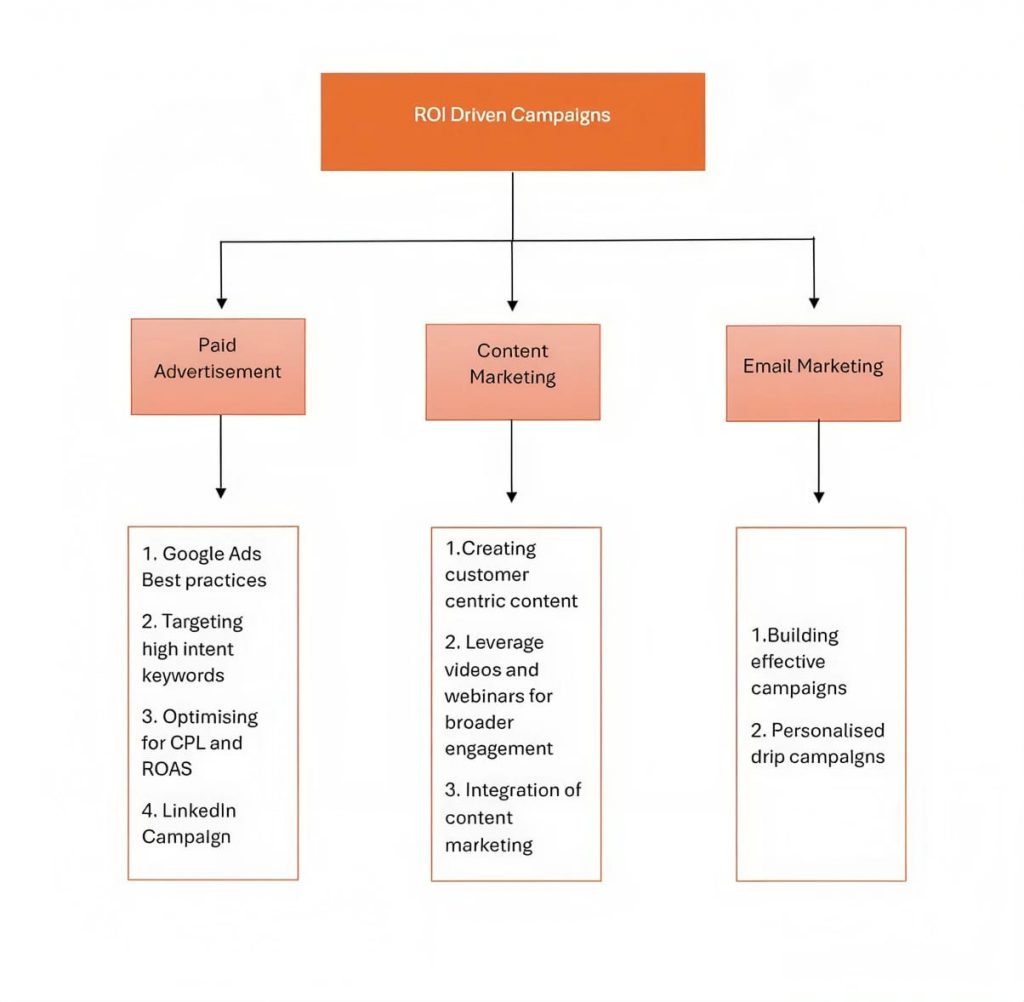
Source: Loop digital
Paid Advertising
Paid advertising hasn’t lost its value, but the way you get ROI from it has changed significantly. A few years ago, throwing budget at broad keywords and letting the platform optimise was good enough for many businesses. That approach is increasingly expensive and increasingly ineffective.
What’s working now is a sharper focus on intent. The businesses seeing the strongest returns from paid media are those targeting people who are close to a decision, not those casting the widest net. That shift has knock-on effects for how you structure campaigns, how you measure them, and how you decide where to scale.
PPC, or Pay-Per-Click, is a digital advertising model where businesses pay a fee only when a user actually clicks on one of their ads. Essentially, it is a way of “buying” targeted visits to your website rather than attempting to “earn” them organically through SEO.
The Budget Calculation Process
Our methodology follows a structured, data-driven approach to ensure every pound spent is aligned with your commercial goals:
- Establish the Estimated CPC: We calculate the average CPC for both the high and low bidding ranges across all selected keywords. By averaging these two figures, we arrive at a balanced Estimated CPC that reflects a realistic entry point for the auction.
- Apply the Multiplier Framework: Once the CPC is established, we use a multiplier approach to define the daily or monthly budget based on the desired level of market competitiveness:
| Multiplier | Strategy Level | Objective |
| 10× CPC | Entry Level | The minimum budget required to start collecting essential data and testing ad copy. |
| 20× CPC | Stable Performance | A balanced budget designed to maintain steady visibility and consistent campaign performance. |
| 30× CPC | Growth Focused | A strong investment level aimed at generating higher lead volume and dominant visibility. |
| 40× CPC | Aggressive Market Leader | Maximum reach is designed for competitive positioning and capturing the highest possible market share. |
- Google Ads: Average UK CPC ranges from £2.15 to £4.50, though high-intent sectors like Finance frequently exceed £15.00.
- Microsoft Ads: In the paid media space, Microsoft Ads has seen a 21% increase in search revenue, largely due to its 100 million daily active users engaging with Copilot and AI-powered search. For UK businesses, this remains a high-value alternative, as Microsoft CPCs average £1.10–£2.10, consistently 30–50% lower than Google Ads. Desktop market share now sits at 12% globally (exceeding 30% in the UK for PC users), making it critical for reaching affluent, professional demographics.
- Amazon Ads: Ideal for businesses selling products on Amazon, these ads help products stand out on the platform and increase sales by reaching interested shoppers.
Social Media Advertising Platforms
- Meta Ads (Facebook & Instagram): These platforms provide advanced targeting options and diverse ad formats. They’re particularly effective for brand awareness and retargeting campaigns. Facebook costs around $0.87 per click, and Instagram costs $1.58 per click.
- YouTube Ads: With video dominating online content, YouTube Ads are a great way to engage audiences. You only pay when someone watches at least 30 seconds or clicks on your ad.
- TikTok Ads: Due to its viral potential, TikTok is a strong choice for reaching younger demographics and achieving high ad engagement. TikTok ads average around $1 per click.
- LinkedIn Ads: B2B benchmarks have risen to £4.00–£12.00 per click, reflecting its premium for targeting senior decision-makers.
- Pinterest Ads: If your target audience aligns with Pinterest’s demographic (largely middle-to-upper-class women), shoppable pins can boost conversions.
- Reddit Ads: Reddit provides access to active and engaged communities, with refined targeting options that allow control over ad placement
Target High-Intent Keywords:
Focusing on transactional keywords like “buy running shoes online” often yields higher conversion rates compared to broader informational terms.
- Example: A fitness retailer targeting “best-running shoes under £100” might see a conversion rate of 8%, compared to 2% for “types of running shoes.”
- Marketing costs: £500
- Revenue: £5,000
- ROI Calculation: ((£5,000 – £500) / £500) × 100 = 900%.
Optimise for CPL and ROAS:
- Cost Per Lead (CPL) and Return on Ad Spend (ROAS) are critical key performance indicators (KPIs) for measuring marketing ROI.
- Example: A B2B software company spends £2,000 generating 200 leads (£10 CPL). With an average deal value of £500 and a 10% close rate, the ROI on digital marketing would be:
- Revenue: £500 × 20 = £10,000
ROI Calculation: ((£10,000 – £2,000) / £2,000) × 100 = 400%.
Key Takeaways
- Focus Ad Spend on Commercial-Intent Search Terms: Concentrating your advertising budget on high-intent keywords can significantly improve conversion rates and overall ROI.
- Optimise for CPL and ROAS: By effectively managing Cost Per Lead and Return on Ad Spend, businesses can scale their Google Ads campaigns efficiently, leading to increased qualified leads and revenue.
Additional Quick Tips for Maximum Impact
- Use Negative Keywords: Implementing negative keywords helps filter out irrelevant searches, reducing wasted ad spend and improving campaign efficiency.
- Leverage Ad Extensions: Utilise ad extensions such as site links, structured snippets, and callouts to enhance click-through rates (CTR) and improve your Quality Score.
- A/B Test Ad Copy: Regularly test different headlines, descriptions, and calls to action (CTAs) to identify which variations yield the highest conversions.
- Optimise Landing Pages: Ensure that traffic from ads lands on fast-loading, conversion-optimised pages with clear CTAs to maximise engagement and sales.
Google Ads Best Practices
Google Ads remains a cornerstone of many digital marketing campaigns, offering the ability to target high-intent audiences actively searching for products or services.
LinkedIn Campaigns
For B2B companies, LinkedIn offers unparalleled precision in targeting professionals.
- Focus on B2B Targeting: Use LinkedIn’s filters (industry, job title, seniority) to ensure ads reach decision-makers.
- Example: A management consultancy firm could target CEOs and CFOs in mid-sized tech companies, leading to a 10% higher ROI compared to broader targeting.
- Use Analytics for Audience Retargeting: Retargeting website visitors and ad engagers can improve conversion rates by up to 70%, according to LinkedIn studies.
Content Marketing
Why Content ROI Now Depends on Authority, Not Volume?
For a long time, the content marketing playbook was fairly straightforward: produce more, publish more, rank for more keywords. That model is largely broken now.
AI tools have made it trivially easy to generate large volumes of generic content. As a result, Google and other platforms have shifted heavily toward rewarding content that demonstrates genuine expertise and real-world authority. Producing ten average blog posts a month will deliver far less ROI than one genuinely useful, well-researched piece that earns links and trust.
The question to ask of every piece of content now isn’t “will this rank?”, it’s “does this give someone something they couldn’t easily find elsewhere?”
Creating Customer-Centric Content
Content marketing thrives on relevance and value. By aligning content with audience needs, businesses can enhance brand awareness and improve marketing ROI.
In B2B industries, case studies and whitepapers are highly effective in establishing authority and nurturing potential leads. By presenting detailed analyses, success stories, or industry insights, they help position businesses as thought leaders while addressing the specific pain points of their audience. For example, a SaaS company focusing on workplace collaboration might create a whitepaper titled “Improving Team Collaboration: Tools and Strategies for Success.”
This whitepaper could attract 1,000 downloads, each representing a qualified lead. With a lead-to-sale conversion rate of 5%, the campaign could generate 50 new customers. Assuming a revenue per sale of £1,500, the total revenue generated would amount to £75,000. With content creation costs of £2,000, the ROI for the whitepaper campaign can be calculated as follows:
ROI = ((Revenue − Cost) / Cost) × 100
Substituting the values
ROI = ((75,000 − 2,000) / 2,000) × 100 = 3,650%
Check this out:
How to leverage Videos and Webinars for Broader Engagement?
Video content has become one of the more reliable formats for driving engagement across digital channels. The core reason is simple: people retain information better when they watch it than when they read it, and they’re more likely to share it. For businesses, this translates into longer time on site, stronger brand recall, and — when the content is well-targeted — better conversion rates.
Webinars serve a slightly different purpose. They work particularly well in B2B contexts where the sales cycle is longer, and trust needs to be built before a prospect will commit. A well-run webinar gives you a qualified room of people who’ve already shown enough interest to register and turn up, that’s a meaningful signal of intent.
The metrics worth tracking for both formats are engagement rate, lead quality, and conversion rate from viewer to customer. Raw view counts are easy to inflate; what matters is whether the content is moving people further along the buying journey.
Integrating Content Marketing into an ROI Framework
To maximise the impact of videos and webinars, businesses should integrate these content types into a broader marketing strategy focused on measuring and optimising marketing ROI.
Key Metrics to Track
- Engagement Rates: Monitor views, shares, comments, and interactions during videos and webinars.
- Conversion Rates: Track how many viewers or attendees take desired actions (e.g., signing up for demos or making purchases).
- Lead Quality: Assess the quality of leads generated from webinars through follow-up conversions.
Key Takeaways
- Utilise Video Content: Invest in video marketing to enhance engagement and improve conversion rates across your campaigns.
- Leverage Webinars for Lead Generation: Use webinars as a strategic tool for demonstrating expertise and generating qualified leads.
Additional Quick Tips for Maximum Impact
- Repurpose Content: Transform webinar recordings into blog posts, social media snippets, or email newsletters to extend reach.
- Promote Ahead of Time: Use email marketing and social media to promote upcoming webinars and generate interest.
- Engage During Sessions: Incorporate polls, Q&A sessions, and interactive elements to keep attendees engaged throughout the webinar.
- Follow-Up Post-Webinar: Send thank-you emails with additional resources or offers to nurture leads generated during the session.
Measuring Content ROI
To measure marketing ROI for content, track:
- Engagement Metrics: Page views, social shares, and time on page.
- Lead Conversion Rates: Number of leads generated per piece of content.
3. Email Marketing
Email ROI Remains Strong, But Only When It’s Personal
Email marketing consistently delivers one of the highest ROI figures of any digital channel. That hasn’t changed. What has changed is the threshold for what “good” looks like.
Inboxes are more competitive. Subscribers are more selective. And the businesses still seeing strong returns from email aren’t the ones sending the most; they’re the ones sending the most relevant. Segmentation and personalisation aren’t optional extras anymore; they’re the difference between a campaign that converts and one that quietly drains your budget.
Building Effective Campaigns
- Effective email marketing campaigns require precision and personalisation.
- Segment Audiences: Divide recipients into categories such as cold leads, warm leads, and existing clients.
- Example: A retailer sends a 20%-off coupon to warm leads who abandoned their cart, resulting in a conversion rate of 15%.
Craft Personalised Drip Campaigns:
- Drip campaigns can nurture leads over time, offering tailored content at each stage of the buyer’s journey.
- Example: A travel agency sending a 3-part email series about summer holidays achieves a 25% higher ROI than generic promotional emails.
Measuring Email ROI
To calculate marketing ROI for email campaigns, monitor:
- Open Rates and Click-Through Rates (CTR): High open rates (>20%) and CTR (>3%) signal effective subject lines and content.
- Revenue Per Email:
- Example: A campaign generating £10,000 in revenue from 5,000 emails sent for £1,000 achieves an ROI of:
- ((£10,000 – £1,000) / £1,000) × 100 = 900%.
See this:
Maximise Your Campaign Performance with Loop Digital
Crafting a high-ROI campaign requires more than just setting a budget; it requires a deep understanding of platform mechanics, audience intent, and technical optimisation. At Loop Digital, our certified specialists bridge the gap between “spending” and “scaling.”
Whether you are looking to tap into the high-intent traffic of Google Ads, the professional precision of LinkedIn, or the AI-integrated reach of Microsoft Copilot, we have the expertise to ensure your budget works as hard as you do.
Ready to Scale Your Returns?
If your current campaigns aren’t hitting the benchmarks you expect, it’s time for a professional perspective. Let us help you identify wasted spend and uncover new growth opportunities:
- Book Your Strategy Consultation: Sit down with our PPC and Paid Media experts to discuss your specific ROI targets and lead generation goals.
- Request a Performance Audit: We’ll dive into your existing accounts to identify negative keyword opportunities, quality score improvements, and landing page bottlenecks.
- Custom Forecast: Using our data-driven multiplier framework, we can provide a tailored budget recommendation and revenue projection for your marketing plan.
- ROI is one of the most important aspects of digital marketing. Do not let incorrect metrics or useless tools hold you back. View our wholesome guide on Guide to ROI-Driven Digital Marketing Strategies
Looking for your next opportunity?
Digital marketing careers
We’re always on the lookout for talented individuals to join our ever growing team. If you think you’d be a great match for Loop Digital, we’d love to hear from you.








Join 300+ business owners getting weekly growth strategies - subscribe now.
"*" indicates required fields