

Posted on 18/05/2026 by Selva Kumar
How do I optimise existing content for AI search without losing rankings?
Read Time: 8 minutes
To optimise your existing content for AI search without sacrificing your current rankings, you need to shift your mindset from keyword volume to entity authority.
Instead of focusing solely on ranking at the top of traditional “blue link” results, your goal is to transform your content into a definitive, easily digestible source of truth. By doing so, you ensure that AI tools, such as ChatGPT, Perplexity, and Google’s AI Overviews.
Table of Contents
- How do I optimise existing content for AI search without losing rankings?
- What is the new trinity of SEO vs. AEO vs. GEO?
- How do you optimise for these new “Answer Engines” without losing the organic traffic you’ve spent years building?
- Step 1: Audit your existing content before you touch anything
- Step 2: Add clear, direct answers near the top of the page
- Step 3: Structure your content so AI can actually read it
- Step 4: Build topical authority, not just page authority
- Step 5: Make your expertise, authority, and trust unmistakable
- Step 6: Optimise for natural language and conversational queries
- Step 7: Add schema markup to signal context to AI systems
- Step 8: Don’t sacrifice readability for optimisation
- Step 9: Monitor, Measure, and Iterate
- Key Takeaways
- The Bottom Line
- The search landscape is shifting: Is your business keeping up?
- FAQs
If you’ve been watching the search landscape lately, you’ll have noticed something quietly seismic happening. AI-powered search tools, such as Google’s AI Overviews, ChatGPT Search, Perplexity, and Microsoft Copilot, are changing the way people find information.
And if your content isn’t set up for this new world, you risk becoming invisible, even if you’re currently sitting pretty on page one. The good news? You don’t have to tear everything down and start again. Optimising existing content for AI search is absolutely doable, and when done properly, it actually strengthens your traditional SEO rather than undermining it.
1. What is the new trinity of SEO vs. AEO vs. GEO?
SEO ranks pages in traditional search results; AEO provides direct, concise answers; GEO earns citations within AI-generated responses through unique, expert insights.
AI search is different. Tools like ChatGPT, Perplexity, and Google’s AI Overviews don’t just rank pages; they read them, synthesise information, and generate answers. They’re looking for content that is authoritative, clearly structured, factually accurate, and easy to extract meaning from.
This is where three disciplines come in:
- SEO (Search Engine Optimisation): It is the process of improving your website to make it more visible when people search for products or services. It involves using relevant keywords, creating quality content, and ensuring your site is technically sound so search engines like Google rank it higher.
- AEO (Answer Engine Optimisation): It is the process of tailoring your content to provide direct, concise answers to specific user questions. It focuses on structuring information so that AI assistants and voice search tools can easily find, extract, and credit your site as the primary source.
- GEO (Generative Engine Optimisation): GEO, being a relatively new concept in the realm of digital marketing, is still subject to a range of definitions of diverse understandings. According to the emerging terminology, it is the practice of making your content “citation-ready” for AI models that generate their own responses. It focuses on adding unique data and expert insights so that AI tools like Gemini or Perplexity choose to reference your brand as a trusted source.
The brilliant thing is that these three disciplines share a common foundation: high-quality, well-structured, trustworthy content.
How do you optimise for these new “Answer Engines” without losing the organic traffic you’ve spent years building?
Step 1: Audit your existing content before you touch anything
Before you start rewriting, you need to know what you’re working with. Pull up your top-performing pages by using tools like Ahrefs, the ones driving the most organic traffic, and assess them honestly against these questions:
- Does this page directly and clearly answer the main question a user would have?
- Is the information still accurate and up to date?
- Is the content structured with clear headings and logical flow?
- Does it demonstrate genuine expertise, or does it read like it was written to game an algorithm?
Make a simple spreadsheet. Flag pages that need a light refresh versus those that need a more substantial overhaul. The goal here is not to rewrite everything; it’s to identify the gaps.
Step 2: Add clear, direct answers near the top of the page
AI systems, particularly those powering AEO, are looking for direct answers. If someone asks, “How do I optimise existing content for AI search?”, they want a concise, usable answer, not five paragraphs of preamble before you get to the point.
A practical technique here is what’s sometimes called the “inverted pyramid” approach: lead with the answer, then expand on it below. Think of it like a news article; the most important information comes first, and the details follow.
For each piece of existing content, ask yourself: What is the single most important thing this page is trying to say? Then make sure that thing is clearly articulated within the first 100–150 words.
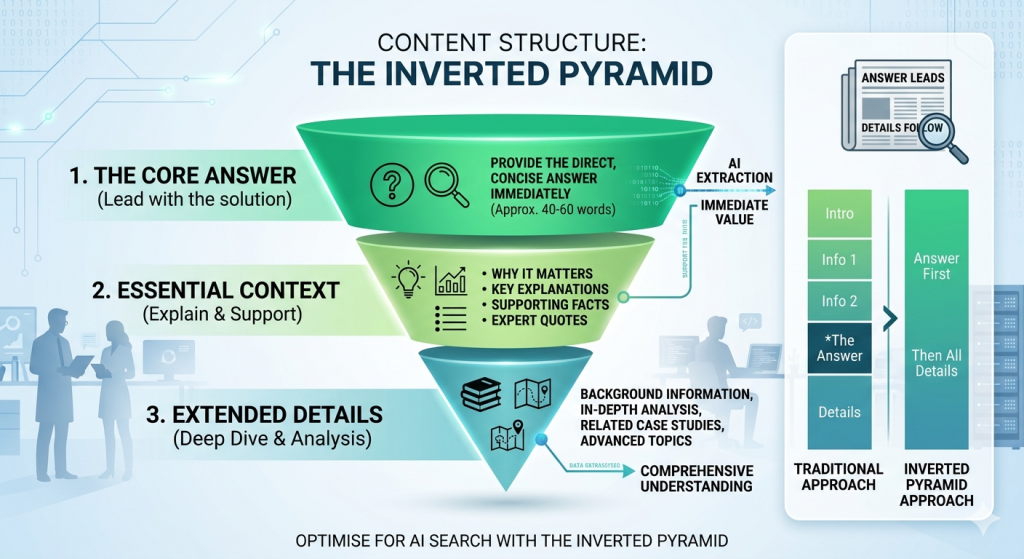
This doesn’t mean stuffing your intro with keywords. It means being genuinely useful, immediately.
Step 3: Structure your content so AI can actually read it
AI tools parse content the same way a careful human reader would; they follow the logical flow, pick up on headings, and look for patterns of meaning. So structure matters enormously.
Here’s what good structure looks like for AI search:
Use descriptive H2 and H3 headings: Vague headings like “More Information” or “Key Points” don’t help AI systems understand what a section is about. Specific headings like “How to Update Old Blog Posts for AI Search” are far more useful.
Use short paragraphs: Long, dense blocks of text are harder for AI to parse and extract meaning from. Aim for three to five sentences per paragraph, max.
Use FAQ sections: This is one of the most powerful things you can do for AEO. Questions mirror the way people actually search, especially with voice search and conversational AI. Adding a well-crafted FAQ to your existing content gives AI tools a ready-made set of answers to pull from.
Use lists and tables where appropriate: These formats are highly extractable, meaning AI tools can lift them into generated responses more easily. If you’re explaining a process, a numbered list often works better than prose.
Step 4: Build topical authority, not just page authority
One of the biggest shifts in how AI systems evaluate content is the move from individual page authority to topical authority. In other words, it’s not just about whether one page is well-optimised; it’s about whether your site as a whole demonstrates deep expertise on a given subject.
If you publish a single blog post about, say, content marketing, that’s fine. But if you have thirty thoughtful, well-researched pieces covering every angle of content marketing, strategy, execution, measurement, tools, and case studies, AI systems are far more likely to treat your site as a go-to source.
For existing content, this means two things:
Create content clusters: Identify your core topics and ensure your existing content is logically linked. A pillar page, a comprehensive guide on a broad topic, should link out to more specific, supporting articles. Those articles should link back to the pillar. This structure signals topical depth to both traditional search engines and AI tools.
Fill the gaps: Your audit in Step 1 will likely reveal topics you haven’t fully covered. New content that fills those gaps strengthens the entire cluster and makes it more likely that AI systems will cite your site when answering questions in that space.
Step 5: Make your expertise, authority, and trust unmistakable
Google’s E-E-A-T framework (Experience, Expertise, Authoritativeness, Trustworthiness) has been around for a while, but it’s become even more important in the era of AI search. AI tools prefer sources that are credible and trustworthy, so you need to make sure your credibility signals are visible.
For existing content, review the following:
Author bios: If your blog posts don’t have author bios, add them. Make them specific; mention qualifications, years of experience, and areas of specialism. A bio that says “Jane Smith is a content strategist with ten years’ experience working with B2B SaaS companies” is far more credible than “Written by the editorial team.”
Citations and references: When you make factual claims, link to credible sources, academic studies, industry reports, and reputable publications. This signals to AI systems that your content is grounded in evidence.
Update dates: AI tools pay attention to how fresh the content is. If a page was last updated in 2019, it’s likely to be deprioritised. Add a “Last Updated” date to your content and actually keep it current.
About pages and contact information: Thin or missing “About” pages raise trust flags. Make sure your site clearly explains who you are, what you do, and how people can reach you.
Step 6: Optimise for natural language and conversational queries
The way people search has changed. Voice search, conversational AI assistants, and chatbots have all trained users to phrase queries as natural questions rather than keyword fragments. Instead of typing “content AI optimisation tips”, someone might now ask, “What’s the best way to optimise my blog content for AI search engines?”
Go through your existing content and look for opportunities to incorporate natural, conversational language, particularly in headings and the first sentence of each section. You don’t have to abandon keywords entirely; rather, you want to layer natural phrasing on top of your keyword strategy.
Long-tail keywords, specific, multi-word phrases, are particularly valuable here. They tend to match more closely with how AI-generated queries are phrased, and they’re often less competitive than broad terms.
Step 7: Add schema markup to signal context to AI systems
Schema markup is a form of structured data that you add to the backend of your pages. It tells search engines and AI tools exactly what your content is about, whether it’s an article, an FAQ, a product, a recipe, a how-to guide, or so on.
For existing content, the most impactful schema types to implement are:
- Article schema: For blog posts and editorial content
- FAQ schema: For pages with question-and-answer sections
- HowTo schema: For step-by-step guides
- BreadcrumbList schema: To help AI understand your site structure
You don’t need to be a developer to add schema. Tools like Google’s Structured Data Markup Helper or plugins like Yoast SEO (for WordPress) make it relatively straightforward.
Step 8: Don’t sacrifice readability for optimisation
This is where a lot of people go wrong. In trying to optimise for AI, they strip the personality and flow out of their writing and end up with something that reads as if a machine wrote it, which is deeply ironic.
Keep your voice. Keep your examples. Keep your anecdotes. The goal of optimising for AI search is not to write for machines; it’s to write clearly for humans in a way that machines can also understand and cite.
Step 9: Monitor, Measure, and Iterate
Optimising for AI search isn’t a one-time project; it’s an ongoing process. After you’ve updated your existing content, set up a monitoring routine:
Track your traditional rankings in Google Search Console.
Monitor whether your content is being cited in AI Overviews by using tools like Ahrefs. Check whether your site is appearing as a source in tools like Perplexity or ChatGPT Search by running test queries.
Review your traffic at a page level every month. If a page drops, investigate whether the content has gone stale or whether a competitor has produced something more comprehensive.
The search landscape is moving quickly. What works today may need refinement in six months. Build regular content reviews into your workflow.
Key Takeaways
- Optimising for AI search (AEO and GEO) and traditional SEO are not opposing goals — they reinforce each other when done correctly.
- AI tools like ChatGPT, Perplexity, and Google’s AI Overviews prioritise content that is clear, credible, well-structured, and directly answers user questions.
- Auditing your existing content before making changes is essential; not everything needs a full rewrite; some pages just need a light refresh.
- Direct, concise answers near the top of your page dramatically improve your chances of being cited by AI-powered answer engines.
- Topical authority matters more than ever; a cluster of well-linked, in-depth content on a subject signals expertise to both search engines and AI systems.
- E-E-A-T signals (Experience, Expertise, Authoritativeness, Trustworthiness), such as author bios, citations, and up-to-date information, are critical for AI search visibility.
- Schema markup helps AI tools understand what your content is about and makes it significantly more extractable for featured snippets and AI Overviews.
- Natural, conversational language and long-tail keywords align better with how people query AI tools and voice search.
- Content optimisation for AI search is an ongoing process, not a one-time fix; regular monitoring and iteration are non-negotiable.
- The sites that will win in AI search are those that write for humans first, with clarity and structure that machines can also easily process.
The Bottom Line
Optimising existing content for AI search doesn’t have to mean throwing out everything that’s already working. In most cases, it means making your content clearer, more structured, more credible, and more directly useful, which are the same things that make content perform well in traditional SEO.
The sites that will thrive in the era of AI search are those that treat their content as a genuine resource rather than a ranking mechanism. Answer real questions. Demonstrate real expertise. Structure your content so both humans and machines can extract value from it quickly.
Do that consistently, and you’ll find that optimising for AI search and maintaining your existing rankings aren’t in conflict at all; they’re two sides of the same coin.
The search landscape is shifting: Is your business keeping up?
Don’t Let Your Competitors Claim the AI Search Space You’ve Already Earned
Every day that your content isn’t optimised for AI search, answer engines, and generative tools is a day your competitors have the opportunity to step into that space instead. The brands appearing in AI
Overviews, being cited by ChatGPT, and surfacing in Perplexity results right now aren’t there by accident; they’re there because they acted early.
At Loop Digital, we specialise in future-proofing your digital presence across SEO, AEO, and GEO, so you don’t just survive the shift to AI-powered search, you lead it.
Here’s what we can do for you:
- SEO: Build and protect your organic rankings with a strategy that’s built for longevity, not just today’s algorithm.
- AEO: Position your content as the go-to answer source for featured snippets, voice search, and AI Overviews.
- GEO: Get your brand cited, referenced, and recommended by the generative AI tools your customers are already using every day.
- Check out our industry updates to stay on top of the learning curve in the dynamic world of digital marketing.
- Subscribe to the Loop Digital Newsletter → Join thousands of marketers and business owners who stay one step ahead.
The window to establish authority in AI search is open right now, but it won’t stay that way for long.
FAQs
1. Will optimising for AI search hurt my existing Google rankings?
Not if done correctly. The principles behind AEO and GEO, clear structure, authoritative content, direct answers, and strong E-E-A-T signals, align closely with what Google already rewards. In most cases, optimising for AI search actually strengthens your traditional rankings rather than undermining them.
2. What is the difference between AEO and GEO?
AEO (Answer Engine Optimisation) focuses on getting your content selected as the direct answer in tools like Google’s featured snippets and AI Overviews. GEO (Generative Engine Optimisation) is about getting your content cited or referenced by generative AI tools like ChatGPT, Perplexity, and Google Gemini when they generate responses. Both disciplines share similar foundations but target slightly different AI-driven touchpoints.
3. How long does it take to see results from AI search optimisation?
It varies depending on your domain authority, content quality, and how competitive your niche is. Some content updates, particularly adding FAQ sections or schema markup, can show results within a few weeks. Broader topical authority building is a longer-term play, typically showing meaningful results over three to six months.
4. Do I need to create brand new content, or can I just update what I already have?
You can absolutely start with what you already have. Updating existing content is often quicker and more effective than starting from scratch, especially for pages that already have some authority and traffic. Focus first on your highest-performing pages and bring them up to AI search standards before investing in new content.
5. Which AI tools should I be optimising for?
The most important ones right now are Google’s AI Overviews (which affects the largest search audience), Perplexity (a fast-growing AI search engine), ChatGPT Search, and Microsoft Copilot. Each has slightly different behaviours, but content that is well-structured, credible, and clearly written tends to perform well across all of them.
6. Will AI search decrease the amount of traffic coming to my website?
It depends on your content type. Informational queries (e.g., “What is…”) often see a drop in click-through rates because AI Overviews provide the answer directly on the search page. However, for commercial or complex queries, the traffic that does click through is often higher quality and further down the sales funnel. By being cited as a source in an AI response, you build brand trust that often leads to direct searches for your business later on.
7. What does it mean to make content “extractable” for AI?
Extractability is the ease with which an AI can “chunk” your information. To improve this, use semantic HTML (like <table> for data and <ul> for lists) and ensure each paragraph focuses on a single “entity” or concept. Avoid burying key facts in fluffy metaphors; AI tools are looking for a high “fact density.” If a bot can’t summarise your section in two sentences, it’s likely too complex to be used as a primary citation.
8. How often do I need to update existing content to stay relevant in AI results?
AI models—particularly Perplexity and ChatGPT Search—have a documented recency bias. In 2026, content that is more than six months old risks “semantic drift,” where the AI views it as potentially outdated compared to newer sources. Aim for a “rolling refresh” of your top-performing pages every 3–6 months, updating statistics, adding new expert quotes, and ensuring the “Last Updated” schema date is current.
Looking for your next opportunity?
Digital marketing careers
We’re always on the lookout for talented individuals to join our ever growing team. If you think you’d be a great match for Loop Digital, we’d love to hear from you.








Join 300+ business owners getting weekly growth strategies - subscribe now.
"*" indicates required fields