

Posted on 16/12/2025 by Selva Kumar
Google’s Simple Guidance on AI Content: A Marketer’s View
Read time: 5 Minutes
Right then, let’s talk about the single biggest thing shaking up the world of online content: Artificial Intelligence. AI tools are everywhere right now, from writing blogs to generating product descriptions, and if you create content for the web, you’ve probably wondered what Google really thinks about all of this. Are AI-written articles allowed? Will Google penalise your site? Or is using AI actually a good thing?
There’s a mountain of jargon and a lot of scaremongering out there about whether Google is going to penalise everything written by a bot. The truth is much simpler (and far less scary) than many people think.
Google isn’t anti-AI. In fact, it’s been using automation in search results for years. What Google cares about is the quality of your content, whether it genuinely helps people, whether it feels trustworthy, and whether it reflects real experience and expertise.
We aim to break down Google’s official stance on AI-generated content in plain, everyday language. No jargon. No complicated algorithm talk. Just a clear explanation of what Google wants, what it doesn’t, and how you can confidently use AI without harming your search performance.
Let’s make sense of it all.
The Short Version
Google does not mind if you use AI to help write your content.
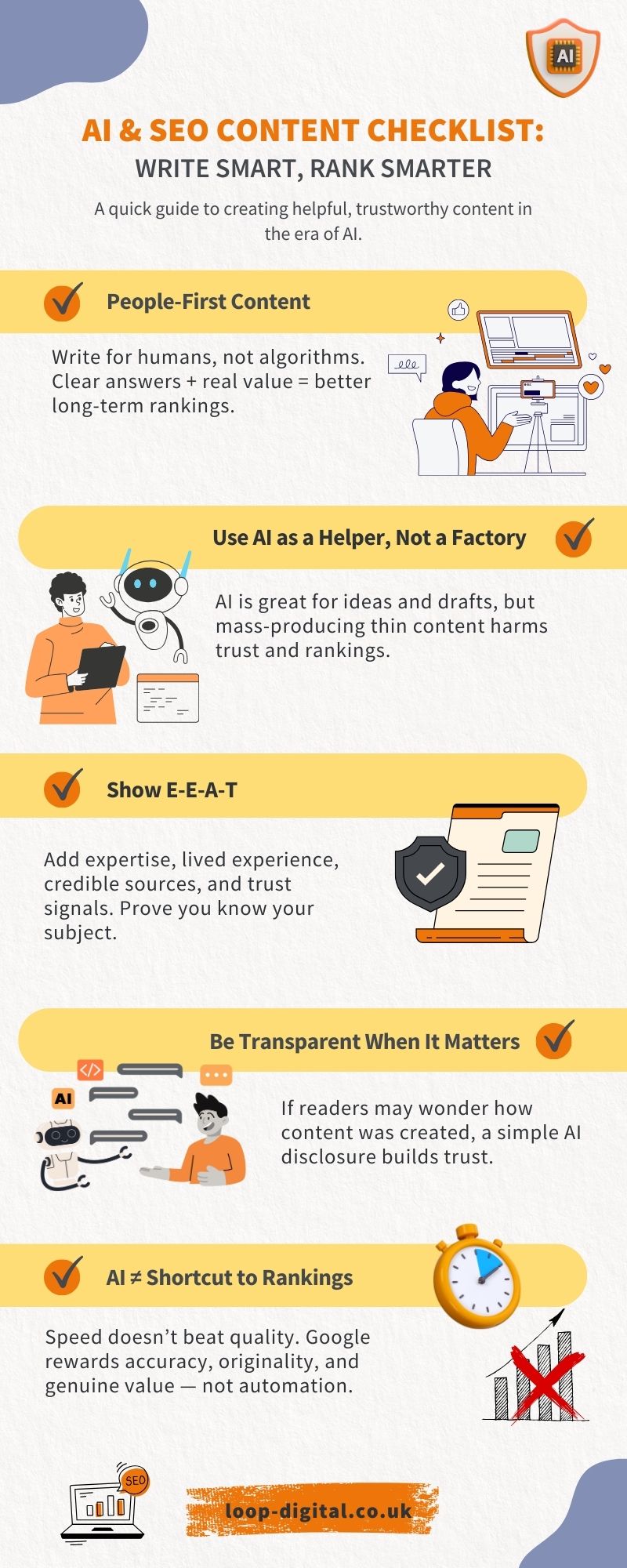
Google doesn’t ban AI-made content. What matters is whether the content is helpful, original and written for people, not just to trick search engines. If your content genuinely helps people and shows expertise and trustworthiness, it can rank well, whether you used AI or not.
Big Idea: Quality Over How It’s Made
Google’s systems try to reward high-quality content. Content that shows E-E-A-T:
- Experience (someone who actually knows or has done the thing),
- Expertise (they know what they’re talking about),
- Authoritativeness (people listen to them),
- Trustworthiness (you can rely on the info).
If you use AI to create unique, helpful, and high-quality content that demonstrates E-E-A-T, Google views it as a helpful tool, just like a spellchecker or a data visualisation programme. The penalty is for the intent to spam, not the technology itself.
Your next read should be: What is E-E-A-T and How Can You Optimise It?
When AI is Fine, and When It Isn’t
Fine: Using AI to help create things like game-day scores, weather reports, and transcripts, or to assist writers, is okay. AI can make content faster and more creative.
- Data-Driven Reporting: AI excels at turning structured data into understandable text. Things like game scores, stock market updates, or weather forecasts are perfect examples. The AI isn’t injecting its opinion or experience; it’s simply presenting factual information quickly and accurately, which is genuinely helpful to users. (Note: It is always better to fact-check your information from AI. Most AI will also provide disclaimers that they are subject to making mistakes, and the reader needs to be careful.)
- Assisting Creativity: AI can be used like a powerful assistant, helping a writer brainstorm, refine drafts, or summarise research. The human remains the director, ensuring the final product demonstrates that essential E-E-A-T (Expertise, Experience, etc.).
Intrigued? Learn more on: Can AI Think? Debunking AI Limitations
Not fine: Using AI mainly to game search results, to pump out low-quality pages that exist just to rank, is treated as spam. Google has tools (like SpamBrain) designed to spot and fight that.
- The Intent to Manipulate: The issue isn’t the AI’s existence; it’s the intent to bypass quality standards. This usually involves creating vast amounts of “thin content”, pages that are low-quality, repetitive, and exist primarily to rank for a specific keyword rather than to help a person.
- The SpamBrain System: Google’s systems, including SpamBrain, are designed to detect patterns of unnatural content creation at scale. They look for signals that suggest a publisher is prioritising search engine manipulation over providing real value.
The simple rule is: Use AI to make your content genuinely better, not just more abundant.
How Google Stops Poor Content From Taking Over
Poor content, whether written by humans or AI, is an old problem. Google uses lots of systems to judge quality and push down low-value stuff. They’re always improving these systems, especially for topics where accuracy matters (health, finance, civic info).
- The E-E-A-T Framework (The Benchmarking Criteria): As we’ve discussed, this is the fundamental quality standard. The ranking systems are designed to identify content that successfully demonstrates Experience, Expertise, Authoritativeness, and Trustworthiness. If content fails to meet this high standard, it has a low chance of ranking.
- The Helpful Content System (HCS): This major, sitewide system was introduced to target content created primarily for search engines rather than for people. It essentially pushes down sites that have a large amount of low-value, unhelpful content, regardless of how it was created.
- SpamBrain: This is the AI-powered system designed specifically to detect spam and manipulation. It catches everything from link spam to content manipulation (like the low-quality AI churning we discussed before) and actively removes it from search results.
- Core Ranking Systems: This is the massive collection of algorithms (including famous ones like PageRank) that judge everything from the relevance of keywords to the quality of backlinks. They work together to assess the overall helpfulness and reliability of a piece of content.
We think you’ll like this too: How to Rank in Google’s AI-Driven Search (2025)
Prioritising Accuracy on Critical Topics
Google applies an even stricter quality lens to topics where accuracy is critically important, such as:
- Health Information: Advice on medical conditions or treatments.
- Financial Information: Investment advice or tax guidance.
- Civic Information: Voting procedures or public safety warnings.
These are often referred to as Your Money or Your Life (YMYL) topics. For YMYL, the systems place a much greater emphasis on the signals of Trustworthiness and Authoritativeness, meaning content from established experts or institutions is heavily favoured.
The Creator’s Checklist: Who, How, and Why
This framework is your quick test for whether using AI is ethical and aligned with Google’s goals.
- Who is the content for? (People First)
The aim is to create content that provides a great experience for a real person reading it. If your primary audience is the search engine algorithm (you’re just stuffing keywords and making it look relevant), you’re on the wrong track. Your content should answer a specific human need or question.
- How was it made? (The Human Touch)
This is where you inject the E-E-A-T. If an AI generates a draft, the ‘How’ requires a human expert to review, refine, and verify the information. Did someone who actually knows the topic check the facts and add a unique experience? If you just published the AI’s first draft without verification, the ‘How’ fails, and so does the trustworthiness.
- Why was it made? (Honest Intent)
The ‘Why’ is your ultimate intent check. If the reason is “to churn out cheap content fast”, Google sees that as manipulation. If the reason is “to genuinely help our audience by giving them unique insights efficiently,” that’s the positive intent Google rewards.
If you like this, you might also like: The content marketing fundamentals
Bylines and Disclosures
- Bylines: If readers reasonably want to know “who wrote this”, include an accurate author byline, especially for journalism or news content.
- AI disclosures: Consider telling readers when AI played a significant role, particularly when people might reasonably ask, “How was this made?” It’s helpful and transparent.
- Don’t make the AI the author. Saying “AI wrote this” isn’t the best way to show expertise or trustworthiness.
Give this a read as well: Human Copywriting Vs AI-generated content
Elevate Your Content Strategy with Hyper-Personalised Marketing
Ready to take your brand’s content to the next level? At Loop Digital, we specialise in hyper-personalised content marketing designed to deliver powerful, measurable results. Whether your goal is to boost visibility, increase conversions, strengthen engagement, or build long-term authority, we craft tailored content that speaks directly to your audience and supports every stage of their journey.
Our approach isn’t one-size-fits-all; we combine data, creativity, and strategy to create content that feels genuinely relevant, meaningful, and aligned with your business objectives.
If you’re ready to discover what truly personalised content can achieve for your brand, book your free 30-minute consultation today. Let’s talk through your challenges, explore opportunities, and design a content strategy built for real growth.
Contact Loop Digital now and start your journey towards smarter, more effective content marketing.
FAQs
1. Is AI content against Google’s rules?
No, but it’s against the rules if the AI content is made primarily to cheat search rankings.
2. Why doesn’t Google ban AI content altogether?
Automation has always been useful in publishing. AI can produce genuinely useful content, and banning it outright would throw the baby out with the bathwater.
3. Won’t AI spread misinformation?
Misinformation is a risk for any type of content. Google’s systems prioritise reliable sources and higher-quality info, especially on critical topics like health and finance.
4. How will Google spot AI-made spam?
They look for patterns that indicate manipulation – not just the presence of AI. Their systems analyse signals across many pages to detect spammy behaviour.
5. Will AI content rank better?
No. AI gives no special advantage. If the content is helpful, original and demonstrates E-E-A-T, it may rank well. If not, it probably won’t.
Looking for your next opportunity?
Digital marketing careers
We’re always on the lookout for talented individuals to join our ever growing team. If you think you’d be a great match for Loop Digital, we’d love to hear from you.









Join 300+ business owners getting weekly growth strategies - subscribe now.
"*" indicates required fields